
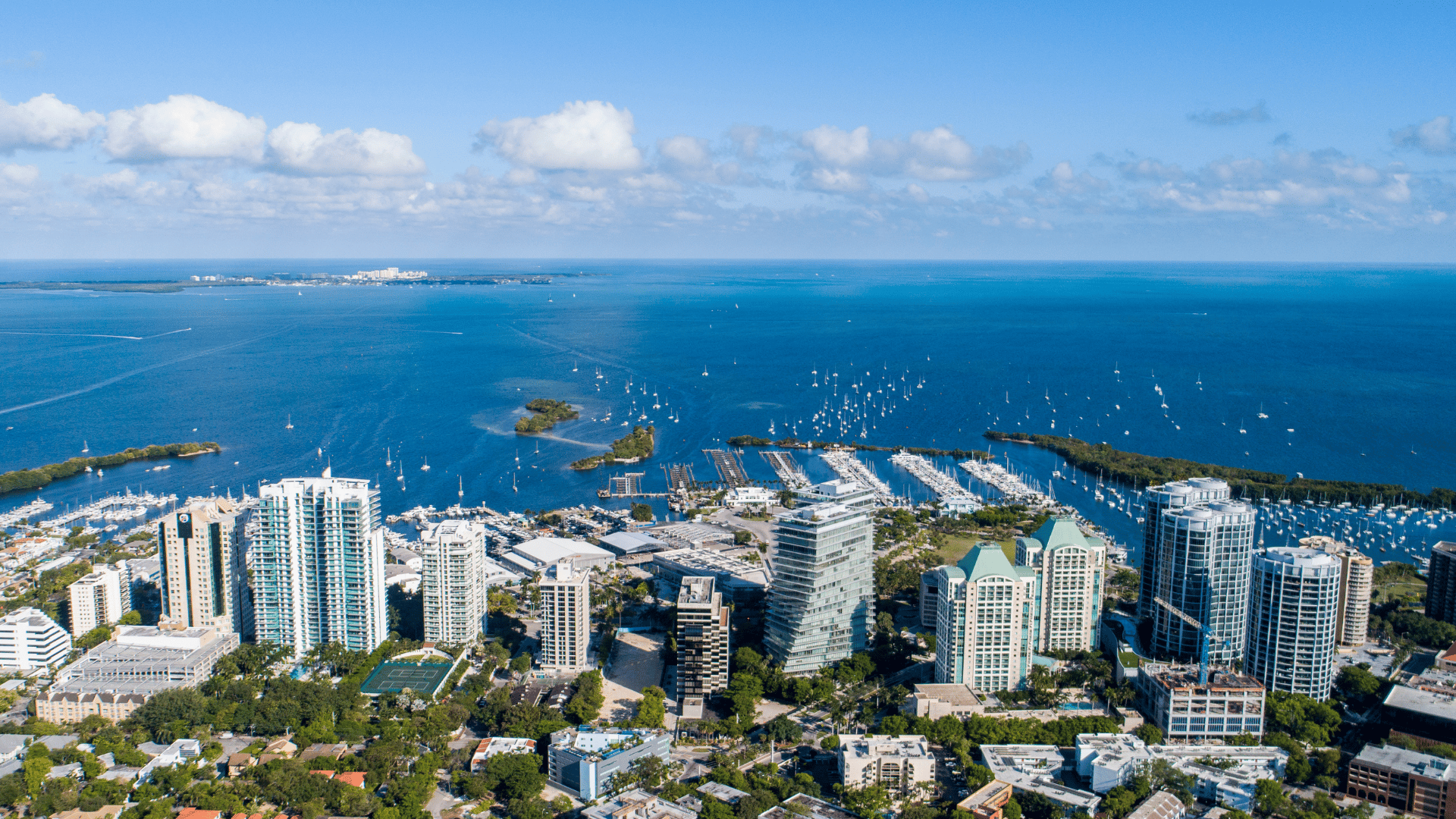
Exploring Coconut Grove: The Perfect Blend of Luxury and Bohemian Living
Most of our work sits on the barrier islands, where the decision is usually about a beach, a line of towers and a view corridor. Coconut Grove is a different exercise entirely. It is the oldest settled neighborhood in the city, it grew around a bay rather than an ocean, and it was built out long before anyone was thinking in terms of setbacks and podium parking. Buyers arriving from the oceanfront markets often expect a version of what they already know, priced differently. It is not that. It is a low-rise, tree-covered village pressed between Biscayne Bay and Coral Gables, and what decides value here is not what decides value in Sunny Isles.
What follows is the orientation we give a buyer before we show anything, and it is worth reading even if you end up elsewhere.
The geography, and why it produces a different kind of street
The Grove runs along the western shore of Biscayne Bay, south of Brickell and east of Coral Gables. Its defining physical feature is elevation: it sits on the Miami Rock Ridge, which is why the earliest settlement happened here rather than on the flats. That ridge is still doing work today, and we will come back to it.
The second defining feature is canopy. Coconut Grove is genuinely shaded, with mature banyans, live oaks and royal poincianas arching over narrow streets that were never widened. This is not landscaping. It is a century of growth that cannot be replicated on a new lot, and it is protected: the tree ordinance means significant specimens are not simply removed because a plan calls for it. Practically, this changes how you read a property. A dry lot with three mature canopy trees and a house you intend to replace can be worth more than a cleared lot of the same size, because the trees are the part you cannot buy back. It also means your site plan has to work around root zones and driplines, which occasionally kills a pool location or a driveway alignment that looked obvious on paper.
Third, the Grove is walkable in a way almost nowhere else in the county is. The village center around CocoWalk and the surrounding blocks is a place people actually walk to, from houses, in the evening. Peacock Park sits at the water. Dinner Key marina and the old city hall are a short distance along the shoreline. Vizcaya Museum and Gardens and The Kampong anchor the northern and southern ends. You can compare that against the other markets we cover on our neighborhoods pages, and the difference is stark: most Miami luxury is drive-to. This is not.
The housing stock is unusually varied for one neighborhood
In a single square mile you can look at four fundamentally different products, and buyers frequently do not realize they are comparing across categories rather than within one.
Older houses, cottages and estates
Frame vernacular cottages, Mediterranean Revival houses, and larger estate parcels, some on or near the water. These carry the most character and the most homework. Assume original wiring and plumbing need replacing, and that roof structures predate current code.
Mid-century houses
A substantial inventory of postwar houses on good lots. These are often the best value proposition in the Grove: solid enough to renovate, modest enough that a sensible addition does not fight the site, and sitting under canopy that a new subdivision cannot offer.
Full-service waterfront condominium buildings
A small number, deliberately so. The Residences at The Ritz-Carlton Coconut Grove and Park Grove are the names most buyers arrive already knowing. If you want staffed, serviced, lock-and-leave living with a bay view, this is a short list rather than the long menu you would find on Collins Avenue. If your search is really a condominium search, our condominium pages will give you a fairer picture of the full county inventory.
New low-rise product
Infill townhouses and small buildings, generally three to five stories, reflecting zoning that has kept the Grove from becoming a tower district. Newer construction means current code, which matters more than most buyers expect once insurance is quoted.
Permitting, historic designation and what older homes really cost
This is the part that surprises people, and it is the reason we walk older Grove houses with a contractor before a buyer gets attached.
Some properties in the Grove are individually designated, and some sit within historic districts. Designation does not prevent you from renovating. It does mean exterior work, additions and demolition go through a design review process in addition to ordinary permitting, and that process has its own timeline and its own opinions about materials, window profiles and massing. If you are planning a full modern reimagining of the street facade, you need to know your status before you are under contract, not after.
Even without designation, the age of the housing stock drives cost. A permitted renovation on a house built decades ago tends to trigger compliance work well beyond the scope you intended: electrical service, impact openings, roof-to-wall connections. None of this is a reason to avoid an older house. It is a reason to price it honestly. We would rather you buy the right house with a real number attached than the wrong one with a hopeful one.
Elevation, flood zone and the water itself
The ridge means elevation varies meaningfully within short distances here, which is unusual for Miami-Dade. Two houses a few blocks apart can carry different flood zone designations, different insurance outcomes, and different practical experience during a heavy rain event. Ask for the elevation certificate. If there is not one, that is information too.
On the water, the Grove is bay frontage, not ocean frontage, and the premium reflects a different set of benefits:
- Dockage. Bayfront lots and several buildings offer private dockage or marina access, with protected water and a straightforward run out to Biscayne Bay. For a boat owner this is the single strongest argument for the neighborhood.
- Seawall condition. On any waterfront purchase here, the seawall is a structural component with a real remaining life and a real replacement cost. Have it assessed.
- View durability. Bay views across open water behave differently from views across a buildable parcel. Confirm what could be built between you and the water.
- Dry lots. Interior Grove lots trade at a substantial discount to waterfront, and for many buyers the canopy and the walk to the village is the actual product. There is no shame in buying the neighborhood rather than the frontage.
Schools, and how families actually decide
The school question drives more Grove purchases than any single architectural feature. The neighborhood contains or sits beside a concentration of strong private schools, including Ransom Everglades and Carrollton, and proximity to them is a genuine value input rather than a talking point: a family that avoids two daily crossings of the city will pay for the address that lets them. There are public options as well, and assignment depends on the specific boundary your parcel falls in, so verify it for the address rather than the neighborhood.
The honest trade-off against the beach markets
We sell on the ocean, so we will be direct about it. The Grove gives you canopy, elevation, walkability, a village center and a boating address. It does not give you an ocean beach at your door, and no amount of bay frontage substitutes for that if morning surf is what you picture. If the beach is the non-negotiable, look at Bal Harbour, Surfside or Golden Beach instead, and accept that you are trading the walkable village for the water.
Buyers who choose the Grove do so for the way the neighborhood lives rather than the way it photographs. Buyers who choose the beach do the opposite. Both are correct, and knowing which one you are saves months.
If you want a straight conversation about it
The most useful thing we can do early is walk both sides of that comparison with real properties rather than in the abstract. You can browse current listings to calibrate, and when you want to talk it through, Jonathan Bigelman's direct line is (786) 246-2068, or you can reach the team through our contact page. No pressure to transact. If the answer turns out to be that the Grove is not your neighborhood, that is a useful outcome too.