
Moving to Miami? A Guide to the Best Luxury Neighborhoods
One of the most common questions I hear from buyers relocating to South Florida is also the hardest to answer in a single conversation: which neighborhood is right for me? Miami is not one market. It is a collection of distinct communities, each with its own price character, lifestyle, and rhythm of inventory, and the differences between them are bigger than most newcomers expect.
Over the years I have represented buyers and sellers across every one of the neighborhoods below, from the oceanfront estates of Golden Beach to the branded towers of Sunny Isles Beach, and increasingly in Coral Gables, where a growing share of my business is now focused. The guidance that follows comes from working these specific markets directly, not from a general view of Miami.
Because I get this question so often, I put together a set of in-depth neighborhood guides covering the communities where I focus my practice. If you are early in your search and want to understand how these areas actually differ, you can browse all of them on my Miami neighborhoods guide. Below is a short orientation to each, with a link to the full write-up wherever you want to go deeper.
Golden Beach
A town of fewer than a thousand residents, Golden Beach is one of South Florida's most private oceanfront enclaves, with no commercial development and no through-traffic, just a stretch of trophy estates. It suits buyers who want absolute privacy and direct beach access, with values typically running from $5M to $50M and above. If it is on your shortlist, my full Golden Beach guide goes deeper.
Settle one question first: ocean side or Intracoastal side. Ocean side is direct beach frontage; Intracoastal side is dockage and protected water, at the cost of walking to the beach rather than stepping onto it. Much of the older stock trades as land, and once that is your plan the decision shifts to what the lot allows: setbacks, height limits, and a permitting timeline.
Bal Harbour
If your priority is a full-service, lock-and-leave high-rise lifestyle, Bal Harbour is the benchmark. It is anchored by Bal Harbour Shops and a cluster of five-star branded towers with concierge-level amenities and direct beach access. Most of the market sits between $2M and $30M and above. You can read more in my Bal Harbour guide.
There are very few oceanfront buildings here, so you are choosing among associations more than among residences. Two nearly identical floor plans can live differently depending on the building's staffing, leasing rules and reserve position, so read those documents as closely as the layout.
Bay Harbor Islands
Two small islands tucked between Miami Beach and Bal Harbour, Bay Harbor offers private docks, top-rated public schools, and a quieter, boutique residential feel that appeals strongly to families and boaters. Expect a range from roughly $1M to $15M and above. My full Bay Harbor Islands guide covers the waterfront and dock specifics.
The two islands are not interchangeable. One is almost entirely single-family; the other carries the multifamily zoning and a steady stream of new low-rise construction. If you own a boat, two measurements decide the search: water depth at the dock at low tide, and clearance under the fixed bridges to open water.
Surfside
Walkable, beachfront, and known for its mid-century character, Surfside sits between Bal Harbour and Miami Beach and tends to draw families who want the beach without the high-rise intensity. It is one of the more approachable entry points into this stretch of coast, generally $1.5M to $25M and above. There is more detail in my Surfside guide.
West of Collins you have a residential grid of houses, many of them mid-century, on blocks where the beach is a walk rather than a drive. On the ocean side you have boutique oceanfront buildings with smaller unit counts and fewer owners sharing the cost of the amenities.
Miami Beach
The defining luxury market of South Florida, Miami Beach spans very different sub-markets, including South of Fifth, Mid-Beach, and North Beach, each with its own price profile and feel. It rewards buyers who know exactly which pocket fits them, with values ranging from $1M to $100M and above. My Miami Beach guide breaks the sub-markets down.
- South of Fifth sits at the southern tip, insulated from the entertainment district above it, and is the most walkable of the three.
- Mid-Beach is the quieter oceanfront stretch along Collins, mixing established buildings with newer development.
- North Beach is the lower-density end, with more mid-century stock and a neighborhood feel.
Sunny Isles Beach
Often called the branded-residence capital of Miami, Sunny Isles is home to names like Porsche Design Tower, Armani/Casa, and the Estates at Acqualina. It draws a heavily international buyer base and a steady pipeline of pre-construction, with most product between $1M and $50M and above. My full Sunny Isles Beach guide has the full picture.
A brand is not only a name on the door: in the better projects it sets the interior specification and brings a hospitality operator and a service standard, which owners carry through the assessments. Much of this market is pre-construction, a genuinely different transaction: staged deposits over the construction period rather than one closing, and a delivery date that is an estimate rather than a promise.
Coral Gables
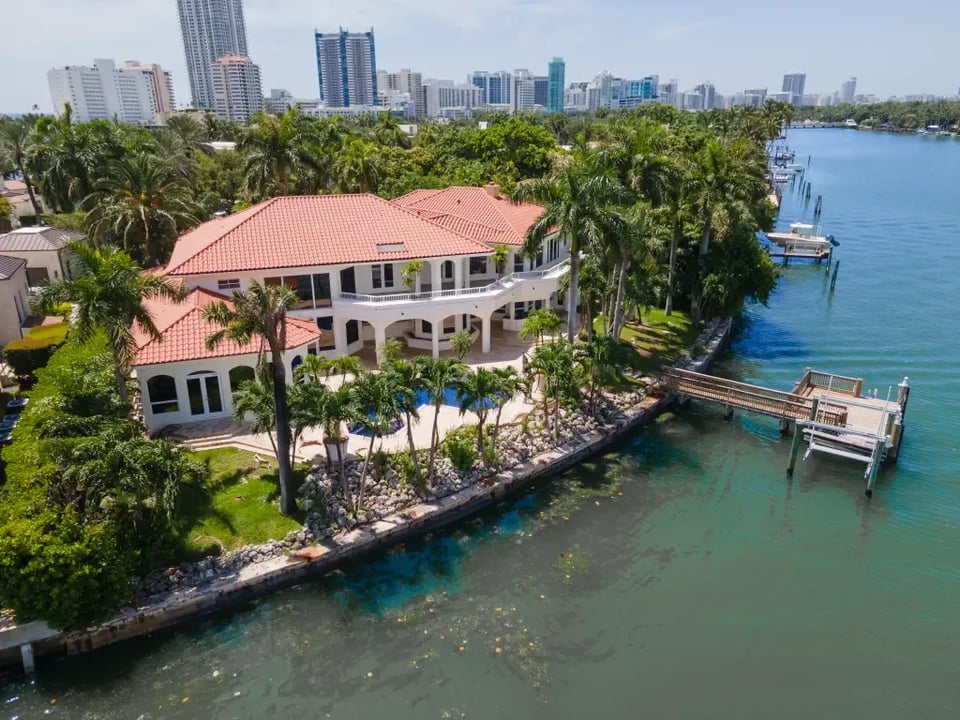
Coral Gables is a different kind of luxury from the oceanfront communities above. Known for its Mediterranean Revival architecture, tree-lined streets, and landmarks like the Biltmore and the Venetian Pool, it offers established elegance, exceptional schools, and a strong sense of permanence. Its guard-gated waterfront enclaves, including Gables Estates and Cocoplum, are among the most coveted addresses in all of Miami. Values span a wide range, from roughly $1.5M to $75M and above, and it has become one of the markets where I am most active.
That architectural character is protected rather than incidental: exterior work goes before a board of architects, so if you intend to renovate or build, design review belongs in your schedule. The mature tree canopy is governed with similar care. In the guard-gated waterfront enclaves, confirm dock depth and bridge clearance out to the bay, which quietly caps the size of boat you can keep at home.
The Questions That Actually Pick the Neighborhood
In practice the area is chosen for you by a handful of ordinary questions.
- Where do the school run and the commute go? This coastline runs on causeways, so a few miles on a map can be a very different drive at eight in the morning.
- Boat or no boat? A boat narrows the map immediately, then narrows it again once draft and bridge clearance are applied.
- House or full-service building? A house is your roof and your seawall. A building is a monthly assessment, a set of rules and a vote.
- How many months a year will you be here? A residence used a few months a year wants a staffed lobby to close it up behind you.
- Primary residence or second home? That changes how you read leasing rules, and how you weigh a pre-construction delivery against something you can move into now.
The Practical Side of Relocating
Flood zone and elevation vary street by street, so look up the specific address rather than assuming the neighborhood answer applies to it.
Insurance is a real line item on this coastline, not an afterthought at closing. Coverage is priced off the construction, the roof, the elevation and the location, so get an indication of cost while you are still weighing properties.
Florida's homestead exemption, and the portability that comes with it, is worth asking a qualified professional about early, particularly if you are establishing a primary residence in the state. I do not advise on tax matters, but it is a conversation buyers are glad they had early. If you already own here, my home valuation page is a place to begin.
Where to Start
Choosing between these communities is rarely about the listings alone. It usually comes down to how you actually live: where your day starts and ends, and which trade-offs matter most to you, such as privacy versus walkability, a single-family estate versus a full-service tower, or established elegance versus new construction. When I work with buyers relocating to Miami, that is where we begin, with your priorities, long before we look at a single property.
If you would like a candid, no-pressure conversation about where you would fit best, and access to opportunities that are not always public, I would welcome it. You can reach me directly at (786) 246-2068.