
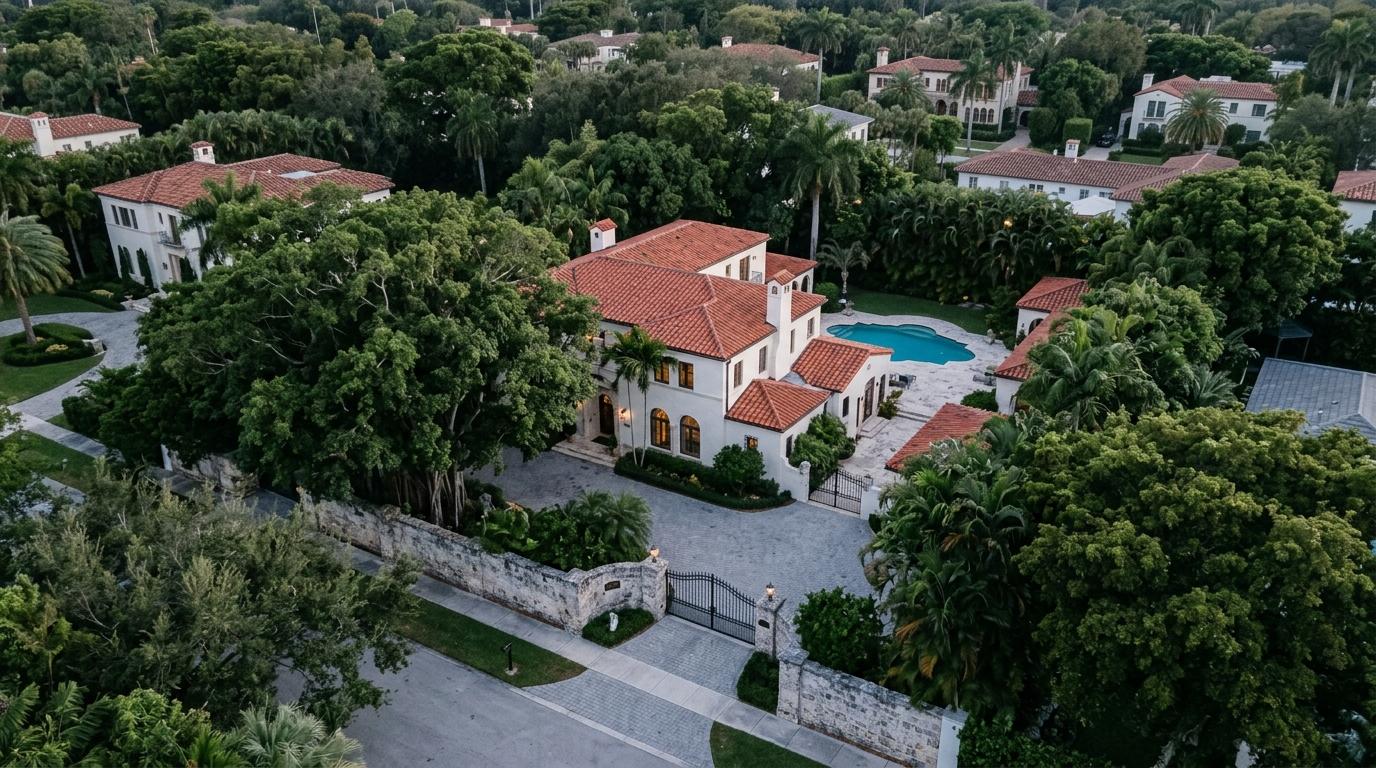
The Art of the Off-Market Sale: How We Sell Miami's Most Exclusive Homes Discreetly
Off-Market Sales Deliver Higher Net Proceeds for Miami's Most Exclusive Homes
Selling a luxury home off-market in Miami means transacting outside the Multiple Listing Service, presenting the property to a curated pool of pre-qualified buyers through private networks, broker relationships, and direct outreach. For properties priced above $5 million, this approach consistently produces stronger net proceeds, shorter negotiation cycles, and complete discretion for sellers who cannot afford a public listing's exposure.
This is not a strategy for every property. It is a precision instrument for significant assets: oceanfront estates in Golden Beach, full-floor penthouses in Sunny Isles Beach, historic compounds in Coral Gables, and trophy units in Bal Harbour's most sought-after buildings. If you are weighing how to sell your Miami penthouse or estate without triggering unwanted publicity, understanding the mechanics of an off-market transaction is the essential first step.
Why Public Listings Work Against Ultra-High-Net-Worth Sellers
The MLS was designed to maximize exposure for typical residential transactions. For a $12 million waterfront home, that logic inverts. Every day a significant property sits on a public listing accumulates market perception of weakness. Buyers and their advisors track days on market obsessively, and a listing that lingers beyond 60 days attracts low-ball offers regardless of the asking price's legitimacy.
Public listings also create security vulnerabilities. Open houses and online photo libraries broadcast floor plans, security configurations, and personal collections to an unrestricted audience. For prominent executives, family-office principals, and international buyers who own Miami real estate as a privacy asset, this exposure directly undermines the reason they purchased the property in the first place.
Finally, public pricing becomes a permanent data point. Once a home is listed, reduced, and ultimately sold, that price history follows every future transaction involving the building or street. Off-market pricing does not enter the public record in the same way, preserving the valuation flexibility of comparable properties nearby.
The Miami Luxury Market Context That Makes Off-Market Viable
Miami's luxury segment has the buyer depth to support off-market transactions at scale. International capital from Latin America, Europe, and the Middle East continues to treat South Florida as a primary destination for wealth preservation. In 2025, Miami-Dade recorded more than 1,200 closed transactions above $3 million, according to county property records, with a meaningful share of those never reaching the public MLS. That buyer pool does not disappear between listing and closing. It circulates continuously through private networks, family offices, immigration attorneys, and global brokerages with Miami relationships.
The neighborhoods where off-market velocity is highest include Bal Harbour, Bay Harbor Islands, Surfside, Golden Beach, Miami Beach's Venetian Islands, and the waterfront streets of Coral Gables. Each of these submarkets has a limited supply of truly significant properties, which means qualified buyers monitor them closely and act quickly when a credible opportunity surfaces privately.
Accurate Miami Home Valuation: The Non-Negotiable Foundation
An off-market sale succeeds or fails at the valuation stage. Price the property too high and you exhaust your private buyer network without a transaction, forcing a public listing at a disadvantage. Price it too low and you forfeit the net proceeds that justified the off-market strategy.
A rigorous Miami home valuation for a significant property involves four distinct inputs:
- Closed comparable analysis: Recent off-market and MLS closed sales within the same submarket, adjusted for floor, view, finish quality, and lot configuration. For condominiums, building-specific comps carry more weight than neighborhood-wide averages.
- Active demand assessment: A real count of pre-qualified buyers currently seeking the property's specific profile, sourced from broker relationships and buyer intake databases. This is not a theoretical number; it is a list of names and net worth documentation.
- Replacement cost analysis: For custom estates, the cost to acquire land and construct an equivalent structure at current labor and material rates. In Golden Beach and Coral Gables, this floor often exceeds what comparable sales suggest, particularly for properties with mature landscaping and irreplaceable architectural detail.
- International buyer premium: Foreign buyers frequently pay above domestic market value for properties that satisfy specific criteria: proximity to top private schools, building security infrastructure, or proximity to a particular cultural community. This premium is real and quantifiable, but only accessible if your agent has the international relationships to identify and qualify those buyers.
The output of this process is a target price range, not a single number. The off-market strategy allows a seller to test the upper boundary of that range with a select group of buyers before any public exposure creates anchoring pressure.
How a Private Miami Luxury Real Estate Agent Structures the Outreach
The mechanics of an off-market campaign differ substantially from a public listing. There is no MLS input, no Zillow syndication, and no open house. Instead, the process unfolds in four structured phases:
- Buyer pool mapping: The listing agent identifies every qualified buyer who has expressed interest in the submarket within the prior 18 months. This includes buyers represented by other brokerages, which requires reciprocal relationships built over years of transactions.
- Private offering preparation: A professional package is produced that includes architectural photography, a detailed floor plan, building or neighborhood data, and a narrative that positions the property's specific attributes. This package is shared under a non-disclosure agreement with qualified parties only.
- Controlled introduction: Rather than simultaneous outreach to all identified buyers, the agent sequences introductions to create genuine urgency. A buyer who knows three other parties have reviewed the package and one has already requested a second showing responds very differently than a buyer who perceives the property as freely available.
- Offer and negotiation management: Off-market transactions often proceed without a formal counter-offer process. The agent manages buyer expectations in real time, which requires constant communication and a clear understanding of the seller's true walk-away terms versus their preferred terms.
Off-Market vs. MLS: A Structural Comparison for Miami Luxury Sellers
| Factor | Off-Market Sale | MLS Public Listing |
|---|---|---|
| Days-on-market perception | No public clock; urgency is managed privately | Every day accumulates and is visible to all buyers |
| Buyer qualification | Pre-screened; proof of funds required before access | Open access; qualification happens after interest |
| Price negotiation leverage | Seller controls information flow; fewer competing data points | Buyers reference all active and sold comps in real time |
| Seller privacy | Transaction details remain out of public view until closing | Address, photos, and price history are fully public |
| Marketing reach | Limited to agent's network; sufficient for properties with specific buyer profiles | Broad exposure; necessary for properties with wider buyer appeal |
| Security risk | Minimal; access controlled through NDA and vetting | Elevated; floor plans and photos publicly available |
| Time to close | Faster when the right buyer is identified; can stall if network is thin | Predictable process; timeline driven by market activity level |
When Off-Market Is the Wrong Choice
Intellectual honesty requires naming the conditions where an off-market approach does not serve the seller's interests. If a property has an unconventional configuration that limits its buyer pool to a very small number of prospects, and none of those prospects are currently active, a private campaign can run for months without a transaction. At that point, a public listing with a recalibrated price often closes faster and at a stronger net number than continuing to wait for the right private buyer.
Similarly, properties in emerging Miami submarkets where price discovery is still developing benefit from MLS exposure because the public listing process itself educates the market about the property's value. Off-market works best in established luxury corridors where buyer expectations and price benchmarks are already well-formed.
The agent's network quality is the single largest variable. An agent with 40 genuine buyer relationships in the $5 million to $20 million range can execute an off-market sale effectively. An agent with three relationships cannot, regardless of how the strategy is packaged to the seller. Ask any agent presenting an off-market proposal to name specific buyers they have worked with in the past 24 months who match your property's profile. The answer tells you everything.
Off-Market Miami Luxury Real Estate FAQ
Does selling off-market mean accepting a lower price?
No. When executed correctly with accurate valuation and genuine buyer demand, off-market sales in Miami's luxury segment frequently close at or above prices achievable through public listings. The absence of days-on-market pressure and competing public bids often allows a seller to hold firm at the upper boundary of the property's value range rather than conceding ground after prolonged market exposure.
How does a Miami luxury real estate agent verify that a private buyer is genuinely qualified?
Standard practice requires proof of funds or a bank letter confirming liquid assets sufficient to close before any property-specific information is shared. For financed transactions, a pre-approval from a private banking division carries more weight than a standard mortgage pre-qualification. The NDA signed before access is a secondary protection; financial verification is the primary gate.
How long does an off-market sale typically take in Miami?
For properties priced between $5 million and $15 million in high-demand submarkets like Bal Harbour, Miami Beach, or Coral Gables, a well-structured off-market campaign typically produces a signed contract within 30–90 days when the agent has an active, relevant buyer pool. Properties above $20 million have a smaller buyer universe and realistic timelines extend to 90–180 days.
Will the sale price remain private after closing?
Florida is not a non-disclosure state, meaning sale prices are part of the public property record after closing. However, the property's marketing history, prior pricing discussions, and negotiation details remain private. Buyers and sellers can also use LLC or trust structures for title, which limits the association between a sale price and an individual's name in public records. An attorney familiar with Florida luxury real estate closings can structure the transaction accordingly.
What information should I have ready before consulting a Miami luxury real estate agent about an off-market sale?
Prepare a clear picture of your timeline, your minimum acceptable net proceeds after commissions and closing costs, any encumbrances on the property, and your specific privacy requirements. If the property has been renovated, gather permitted work documentation and contractor warranties. Buyers at this price point conduct thorough due diligence, and incomplete records create renegotiation leverage during the inspection period that erodes your net proceeds.