
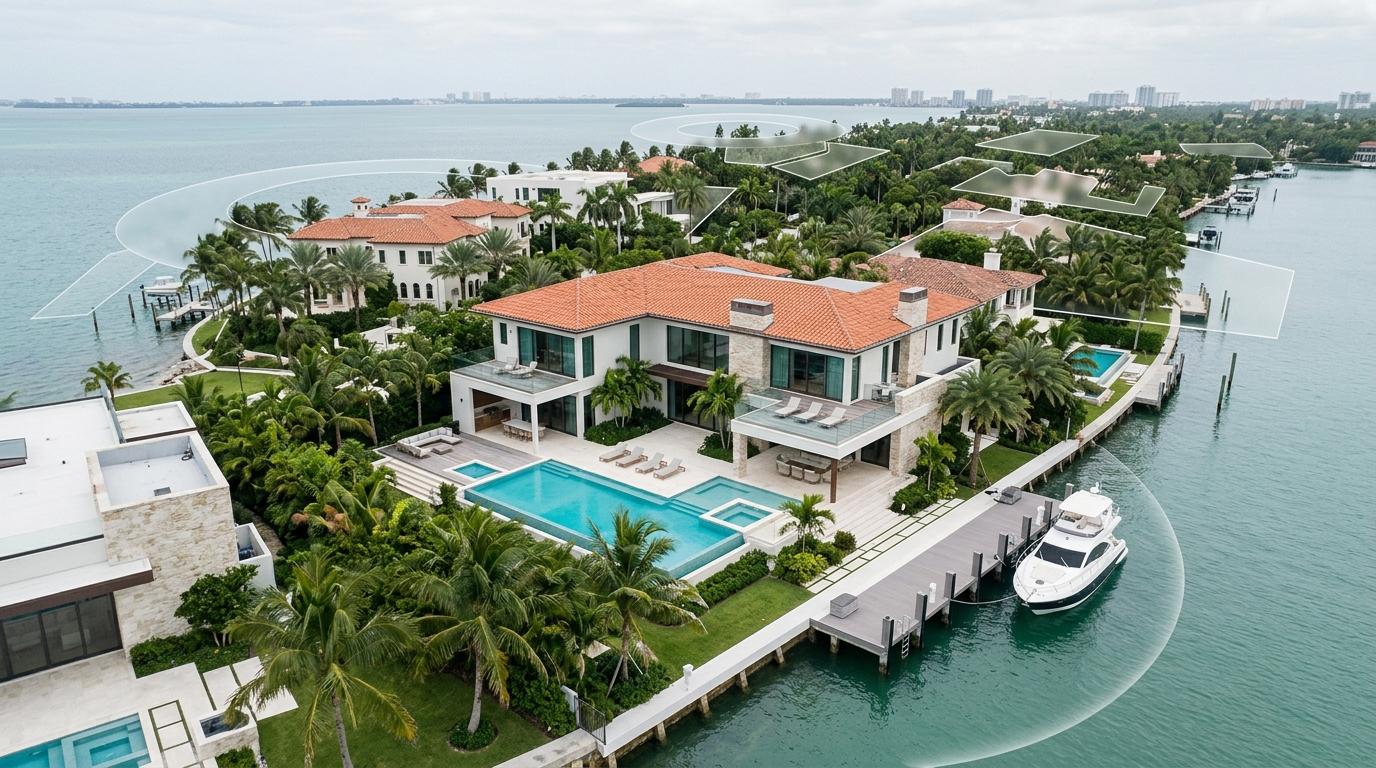
A Digital-First Approach: The Sophisticated Marketing Strategy We Use to Sell Your Miami Property
Selling a Luxury Miami Property Demands a Purpose-Built Marketing Strategy
Selling a luxury Miami property in 2026 requires a documented, channel-specific marketing plan executed before the listing goes live. The buyers for properties priced above $3 million are not browsing the same portals as entry-level homebuyers. They are identified through curated networks, contacted through targeted digital campaigns, and converted through a negotiation process that bears little resemblance to a standard residential transaction. What follows is a precise account of the digital-first methodology we use to position, expose, and close significant Miami real estate.
Why Standard Listing Tactics Fail at the Luxury Price Point
A property entered into the MLS with professional photography and a Zillow syndication is a complete strategy for a $600,000 home. At $5 million and above, it is the bare minimum, and relying on it as the primary engine of exposure leaves real money on the table. Here is why:
- Qualified buyer pool is small and international. The universe of buyers who can close on a $7 million Bal Harbour penthouse without financing contingencies is measured in the hundreds globally, not the thousands locally. Reaching them requires outbound targeting, not passive listing.
- Days on market destroy leverage. A luxury listing that sits for 90 days signals price resistance to every sophisticated buyer's agent watching the market. A tightly executed pre-launch strategy compresses time on market and protects negotiating position.
- Photography alone does not justify the price. Luxury buyers at this level are making asset allocation decisions. They respond to data, lifestyle narrative, and verified comparables, not bedroom counts and granite countertops.
The antidote to each of these problems is a layered marketing architecture that works simultaneously across paid digital channels, the Sotheby's International Realty global network, and a carefully managed off-market pipeline.
Pre-Launch: The Off-Market Advantage in Miami
Off-market real estate in Miami is not a workaround or a sign of a distressed seller. For properties in neighborhoods like Golden Beach, Bay Harbor Islands, and Surfside, an off-market or quiet-market phase is frequently the most powerful tool available. Here is the specific mechanics of how it works.
Before a property is listed publicly, we circulate a confidential brief to a defined list of high-net-worth prospects. That list is built from three sources: active buyer relationships within our own brokerage, the Sotheby's International Realty affiliate network spanning more than 80 countries, and qualified contacts from recent comparable transactions. The brief includes verified square footage, a curated set of interior images, key structural specifications, and asking price guidance. It does not include the address until a nondisclosure or broker-to-broker confidentiality protocol is in place.
The off-market phase typically runs 14–21 days. Its purpose is dual: it surfaces buyers who will pay full price to avoid competition, and it generates market intelligence. If serious interest stalls at a particular price point during the off-market phase, that data informs whether the public pricing strategy needs adjustment before the listing is visible to the broader market. That intelligence is worth far more than the incremental exposure of going public immediately.
Digital Marketing Channels: A Structured Comparison
Once a property moves into its public or semi-public phase, we deploy across multiple digital channels simultaneously. Each channel performs a different function in the buyer journey. The table below maps channel, primary function, and the specific luxury buyer segment it reaches most effectively.
| Channel | Primary Function | Buyer Segment Reached |
|---|---|---|
| Sotheby's International Realty global portal | Tier-1 syndication to ultra-high-net-worth international audience | European, Latin American, and Middle Eastern buyers with U.S. asset interest |
| Targeted Meta and Instagram campaigns | Visual storytelling and retargeting of warm prospects | Domestic high-income households in feeder markets: New York, Chicago, Los Angeles |
| Google Ads (property-specific and neighborhood keywords) | Capture active search intent from buyers already in decision mode | Buyers researching specific Miami neighborhoods and price ranges |
| Email campaigns to broker network | Agent-to-agent distribution of new inventory to qualified buyer pipelines | Represented buyers whose agents are already working a relocation or acquisition brief |
| YouTube and video platforms | Long-form property tours and neighborhood context for remote buyers | International buyers conducting preliminary research before visiting Miami |
| Wall Street Journal, Mansion Global, and luxury editorial placements | Third-party credibility and reach into business-oriented affluent readers | C-suite professionals and investors who consume financial and lifestyle media |
Running these channels in parallel, rather than sequentially, creates overlapping exposure that reinforces brand recall. A buyer who sees a property in a Sotheby's email and then encounters it again in a targeted Instagram video is far more likely to request a showing than a buyer who sees it once in a feed.
Leveraging the Sotheby's Global Real Estate Network
The Sotheby's International Realty global network is the single most valuable infrastructure asset in luxury real estate marketing. With more than 26,000 affiliated agents across 80-plus countries, it functions as an active referral machine, not simply a brand endorsement. When a property is listed within the network, it is visible to agents in Geneva, Hong Kong, London, and São Paulo who are working with clients actively seeking U.S. property.
The practical implication for a Miami seller is significant. Roughly 40 percent of buyers in Miami's top tier of the market in recent years have originated internationally, according to brokerage data from 2024 and 2025. Brazil, Argentina, Colombia, and Venezuela continue to generate demand from buyers seeking dollar-denominated assets and lifestyle properties. European buyers, particularly from France and Germany, have increased their presence in the Sunny Isles Beach and Bal Harbour markets. Without active network distribution, these buyers are invisible to the seller. With it, they are prioritized prospects.
The Negotiation Architecture Behind a Top-Dollar Close
Digital marketing generates inquiries. Skilled negotiation converts those inquiries into closed transactions at the highest defensible price. The two are inseparable, and treating negotiation as a reactive step rather than a planned process is where many luxury sellers leave value behind.
Several mechanics govern effective negotiation at the $3 million-plus level:
- Control the information asymmetry. A sophisticated buyer will arrive with their own data. The listing agent's job is to have a more complete, better-documented comparable sales analysis that justifies the asking price. This means pulling closed data from comparable waterfront or ultra-luxury transactions across Miami-Dade County, not just the immediate neighborhood, and framing the property's unique attributes as value drivers rather than emotional selling points.
- Use offer timing strategically. When multiple parties are interested, managing the pace of offer submission protects the seller. Communicating credible competing interest without manufacturing false urgency is a disciplined skill that requires direct experience in luxury transactions.
- Price concession strategy should be planned before the first offer arrives. Sellers who decide how much flexibility they have in the heat of negotiation make worse decisions than those who have set a pre-negotiated floor with their agent. We establish a walk-away number, a target close price, and a concession sequence during the listing strategy session, not during the negotiation itself.
- Non-price terms are negotiating currency. At the luxury level, closing timelines, furniture inclusions, leaseback arrangements, and inspection scope are all levers. A buyer who wants a 30-day close may accept a price closer to asking than a buyer demanding 90 days and a full inspection credit. Understanding what the buyer values beyond price is the foundation of a maximum-value negotiation.
Content and Data: What Luxury Buyers Actually Respond To
The digital content produced for a luxury Miami listing serves two audiences simultaneously: the buyer and the buyer's advisor. Family office principals, international buyers with legal representation, and repeat real estate investors all make decisions informed by their advisors. Marketing content that includes detailed floor plans, verified HOA financial disclosures, building reserve fund status for condominiums, and a documented property history gives those advisors the information they need to recommend a purchase. Emotional lifestyle imagery is necessary but insufficient.
For new development properties in Miami's active pipeline, this is particularly relevant. Buyers evaluating pre-construction units in Sunny Isles Beach or Brickell are comparing developer credibility, construction timelines, and projected delivery risk alongside price per square foot. A comprehensive digital presentation that addresses those concerns directly converts at a higher rate than one that leads exclusively with renderings.
Miami Luxury Property Marketing FAQ
What is off-market real estate in Miami and who benefits from it?
Off-market real estate in Miami refers to properties marketed privately to a curated buyer list before or instead of a public MLS listing. Sellers benefit from discretion, reduced days on market, and the ability to test pricing without public exposure. Buyers benefit from access to inventory that never reaches the open market, reducing competition at the moment of offer.
How does the Sotheby's International Realty global network improve a Miami listing's performance?
The Sotheby's International Realty network distributes listings to more than 26,000 affiliated agents in over 80 countries. For Miami properties, this creates direct access to buyer pipelines in Latin America, Europe, and the Middle East, the primary international feeder markets for Miami's luxury segment. Properties listed within the network appear on the global Sotheby's portal and are actively circulated to agents representing international clients.
What digital marketing channels perform best for luxury real estate in Miami?
For Miami luxury properties, the highest-performing digital channels are the Sotheby's International Realty global portal for international reach, targeted Meta and Instagram campaigns for domestic feeder markets like New York and Los Angeles, and Google Ads capturing active search intent. Email campaigns to the agent network consistently produce the fastest qualified showings because they reach represented buyers already in an active acquisition process.
How should a Miami luxury seller prepare for negotiation before listing?
Before listing, sellers should establish a documented floor price below which they will not transact, a target close price, and a planned concession sequence. Non-price terms including closing timeline, inspection scope, and personal property inclusions should be identified as potential negotiating levers. This preparation, done before the first offer arrives, produces better outcomes than reactive decision-making during live negotiations.
Does a longer pre-market or off-market phase hurt a luxury property's eventual sale price?
A controlled off-market phase of 14–21 days does not hurt the sale price and frequently improves it by surfacing buyers willing to pay a premium for exclusive access. By contrast, a public listing that accumulates more than 60–90 days on market signals price resistance and weakens the seller's negotiating position. The goal is to use the off-market phase to generate competitive interest before the public phase begins, not to substitute for it indefinitely.