
Digital-First Dominance: The 2026 Marketing Strategy for Selling a Miami Luxury Property
Selling a Luxury Home in Miami in 2026 Requires a Digital-First Strategy
Owners who want to sell a luxury home in Miami in 2026 need to treat digital marketing as the primary sales channel, not a supplement to print or in-person events. Ultra-high-net-worth buyers now conduct the majority of their initial property research through curated digital platforms, AI-powered search tools, and private broker networks before they ever request a showing. A property that is not positioned correctly in those channels will be passed over regardless of its physical merits. This guide covers the specific mechanics of a digital-first listing strategy, from pre-market valuation through closing, for Miami properties priced at $3 million and above.
Accurate Miami Home Valuation Is the Foundation of Every Marketing Decision
A precise valuation is not just a pricing exercise. It determines the buyer pool you are targeting, the platforms where your property should appear, and the narrative your marketing will carry. Overpricing a Miami luxury home by even 8–10% signals to sophisticated buyers and their agents that the seller is uninformed, and it suppresses showing requests from the exact buyers most likely to close.
In 2026, Miami luxury home valuation must account for several variables that did not carry the same weight in prior cycles. These include proximity to private aviation infrastructure at Opa-locka Executive Airport and Miami-Opa Locka Executive Airport, building-level generator and flood-hardening specifications, and a property's certification status under Florida's new wind mitigation standards adopted in late 2024. Waterfront properties in Bal Harbour, Golden Beach, and Sunny Isles Beach require a separate layer of analysis that weights seawall condition, dock permitting status, and navigable water access to open bay versus canal-only positions.
A qualified Miami luxury real estate agent will run a micro-market comparable analysis that isolates sales within the same building tier or street corridor, not simply the same zip code. For penthouses and estate properties where true comparables are scarce, experienced agents use a replacement cost approach layered with income-capitalization modeling if the property has any rental history. This dual-methodology approach produces a defensible price that will withstand scrutiny from a buyer's advisor or wealth manager.
Building the Digital Asset Package Before the Listing Goes Live
The most damaging mistake luxury sellers make is listing a property before the full digital asset package is ready. A Miami penthouse or waterfront estate has one opportunity to make a first impression on a buyer who may be browsing from Dubai, São Paulo, or New York. That window is typically 48–72 hours after a listing appears in a broker's private feed or on a platform like Christie's International Real Estate or One Sotheby's digital network.
A complete 2026 digital asset package for a Miami luxury property includes the following components:
- Cinematic video tour: Minimum 3–5 minutes, shot in 6K resolution, with licensed ambient music and voiceover narration that contextualizes the property's lifestyle, not just its square footage. Drone footage must comply with current FAA Part 107 regulations and Miami-Dade airspace restrictions, particularly in Bal Harbour and the Miami Beach barrier island corridor.
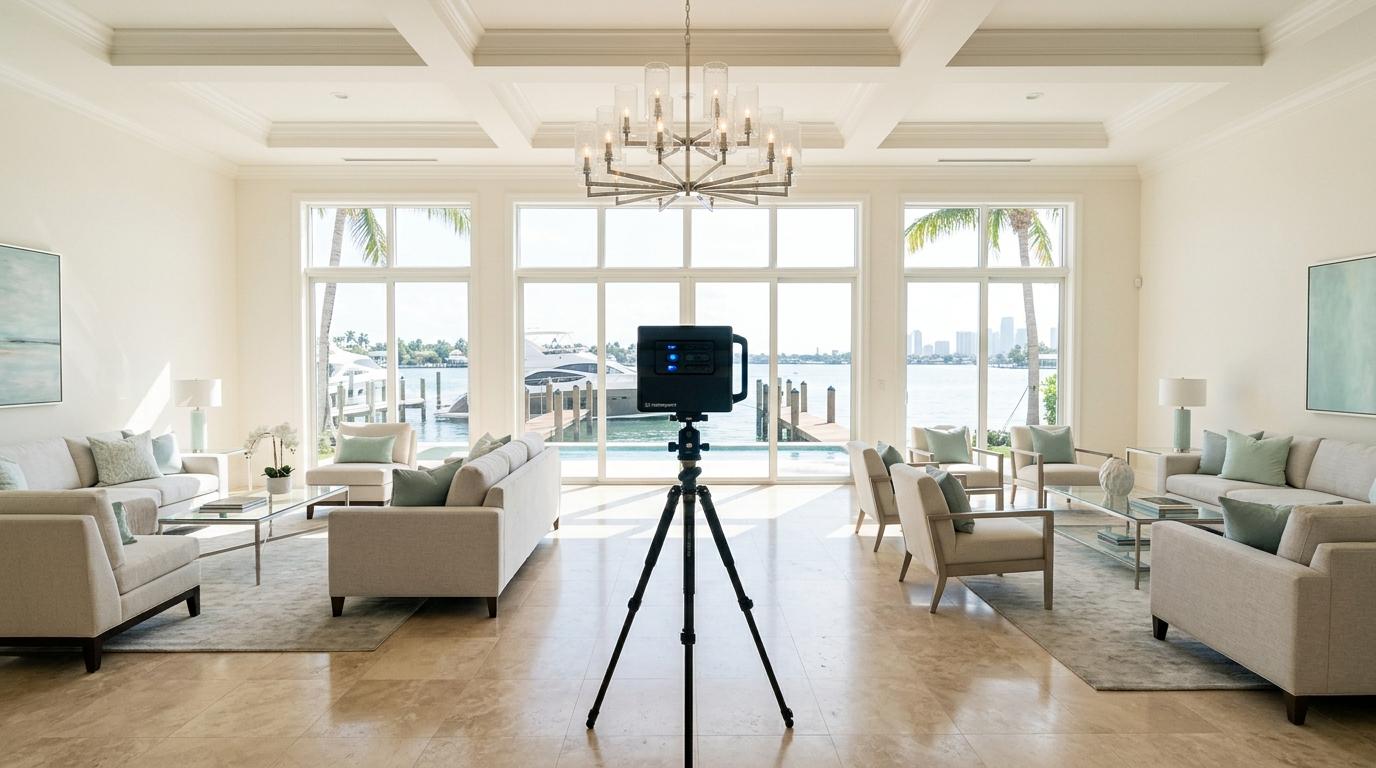
- Interactive 3D virtual tour: Matterport or equivalent platform with embedded metadata, allowing international buyers to measure rooms and review finishes without a physical visit. Properties with a published 3D tour on Zillow's luxury tier receive measurably more saves and shares from out-of-state and international buyers.
- AI-optimized listing copy: Property descriptions written and structured to surface in AI-powered real estate search queries, which a growing share of buyers now use as their first search step. This means specific keyword inclusion, structured amenity lists, and neighborhood context that answers the questions an LLM-based tool would surface: walkability, school district proximity, flood zone classification, and HOA restriction summaries.
- Photography with staging audit: A minimum of 60 professionally edited stills, with a pre-shoot staging consultation to address furniture scale, lighting temperature, and the removal of any personal items that narrow the perceived buyer demographic.
- Translated marketing summaries: One-page PDF summaries in English, Spanish, Portuguese, and Mandarin, distributed through the listing agent's international referral network and embassy real estate contacts.
Platform Strategy: Where Miami Luxury Listings Actually Find Buyers
Not all listing platforms serve the same buyer profile. Distributing a $6 million Sunny Isles Beach penthouse identically across every available portal is not a strategy; it is noise. In 2026, effective platform allocation for Miami luxury property follows a tiered structure.
| Platform Tier | Best For | Primary Buyer Origin | Key Advantage |
|---|---|---|---|
| Tier 1: Brokerage Global Networks | $3M+ properties, penthouses, estate homes | International, domestic UHNW | Pre-vetted buyer referrals from affiliate offices in 50+ countries |
| Tier 2: AI-Enhanced Consumer Portals | $3M–$10M condos and single-family | Domestic relocators, second-home buyers | High search volume, AI recommendation surfacing for targeted buyer profiles |
| Tier 3: Private Off-Market Networks | Ultra-private estates, $10M+, notable sellers | Family offices, hedge fund principals | No public days-on-market clock; maintains price integrity |
| Tier 4: Paid Social and Programmatic | Supplemental reach for all price points | Aspirational buyers, relocation inquiries | Geo-targeted campaigns reaching specific feeder markets like NYC, Chicago, London |
For properties above $10 million, the off-market phase deserves serious consideration before any public listing. A targeted off-market campaign distributed to 200–400 pre-qualified buyers through a seasoned Miami luxury real estate agent's network can achieve a sale at full ask or above, without the stigma that accumulates on a property sitting publicly for 90 or more days.
Navigating the Offer and Negotiation Phase with a Global Buyer
International buyers account for a significant share of Miami luxury closings, and the mechanics of their transactions differ from domestic sales in ways that affect both timeline and structure. A seller whose agent lacks international transaction experience will lose time and potentially the deal during the due diligence and financing coordination phases.
Key structural considerations when selling to an international buyer include the following. FIRPTA withholding requirements under the Foreign Investment in Real Property Tax Act require the buyer to withhold 15% of the gross sale price and remit it to the IRS unless the seller obtains a withholding certificate. Processing a withholding certificate through the IRS takes 90 days on average, which must be built into the closing timeline from contract execution. Sellers who are not U.S. citizens face mirror-image obligations that require coordination with a U.S. tax attorney and, in many cases, a FIRPTA escrow arrangement.
Wire fraud remains an elevated risk in high-value transactions. A Miami luxury real estate agent with a tested closing protocol will require all wire instructions to be verbally confirmed with the receiving title company at a known phone number, never via email alone. This single procedure has prevented losses on multiple Miami closings in the past three years.
Currency fluctuation also affects the effective price for international buyers. A buyer funding a purchase in Brazilian reais or Colombian pesos who experiences a 5% currency shift between contract and closing may need to renegotiate or withdraw. Sellers should understand this risk and structure contracts with clear currency and financing contingency language that protects their position.
How to Sell a Miami Penthouse: Specific Considerations for Vertical Luxury
Penthouses in Miami's luxury condo market, particularly in Sunny Isles Beach, Brickell, and Edgewater, require a distinct marketing approach from single-family estate properties. The buyer for a $5 million penthouse is frequently a corporate executive or international investor who prioritizes privacy, building-level amenities, and lock-and-leave convenience over land ownership and outdoor space.
Marketing a penthouse effectively means leading with the building's service infrastructure: concierge staffing ratios, private elevator access, spa and wellness facility quality, and the building's pet and rental policies. In 2026, buyers also scrutinize building financials. A penthouse in a building with an underfunded reserve or a pending special assessment will face a price discount of 10–20% regardless of the unit's finish quality. Sellers should obtain a current copy of the building's financial statements and reserve study and share them proactively during due diligence to eliminate uncertainty that suppresses offers.
Floor plan orientation matters significantly in the Miami market. Units with unobstructed ocean views to the east and city-light views to the west command a 15–25% premium over comparable square footage with bay or interior views. Documenting and verifying protected view corridors through Miami-Dade planning records and including that documentation in the listing package is a detail that separates well-represented penthouses from those that linger on the market.
Miami Luxury Real Estate Selling FAQ
How long does it typically take to sell a luxury home in Miami in 2026?
Well-priced Miami luxury properties in the $3M–$7M range are trading at an average of 45–75 days on market when listed with complete digital marketing packages and strong broker network distribution. Properties above $10M with fewer natural comparables average 90–150 days, though off-market campaigns for well-connected sellers can close in 30 days or less.
What is the most accurate way to value my Miami penthouse before listing?
A micro-market comparable analysis isolating same-building or same-corridor closed sales within the past 18 months, layered with a replacement cost analysis and an adjustment for current building financials and view corridor protection, produces the most defensible valuation. A single Zestimate or automated valuation model is not sufficient for properties above $3M.
Should I sell my Miami luxury home off-market or publicly listed?
Off-market is the preferred approach for properties above $10M, for sellers with significant public profiles, and for properties with recent upgrades that make public days-on-market data misleading. Public listing is more appropriate for properties in the $3M–$8M range where broad exposure accelerates competitive offer situations and supports price discovery.
How do I find a Miami luxury real estate agent qualified to handle an international transaction?
Look for an agent with active membership in a global brokerage network such as Christie's International Real Estate, One Sotheby's International Realty, or Douglas Elliman's international division. Verify that they have personally closed transactions involving FIRPTA withholding, foreign national financing, and wire fraud prevention protocols. Ask for specific closed transaction references, not just testimonials.
What upgrades add the most value before listing a Miami luxury home?
In 2026, the highest-return pre-listing investments in the Miami luxury market are whole-home generator installation (impact on buyer confidence for post-hurricane-season buyers is significant), hurricane impact window and door upgrades to current Miami-Dade Product Approval standards, and smart home system integration with a single-app control platform. Cosmetic renovations such as kitchen resurfacing and bathroom fixture replacement typically return 60–80 cents on the dollar at this price point and are secondary priorities.