
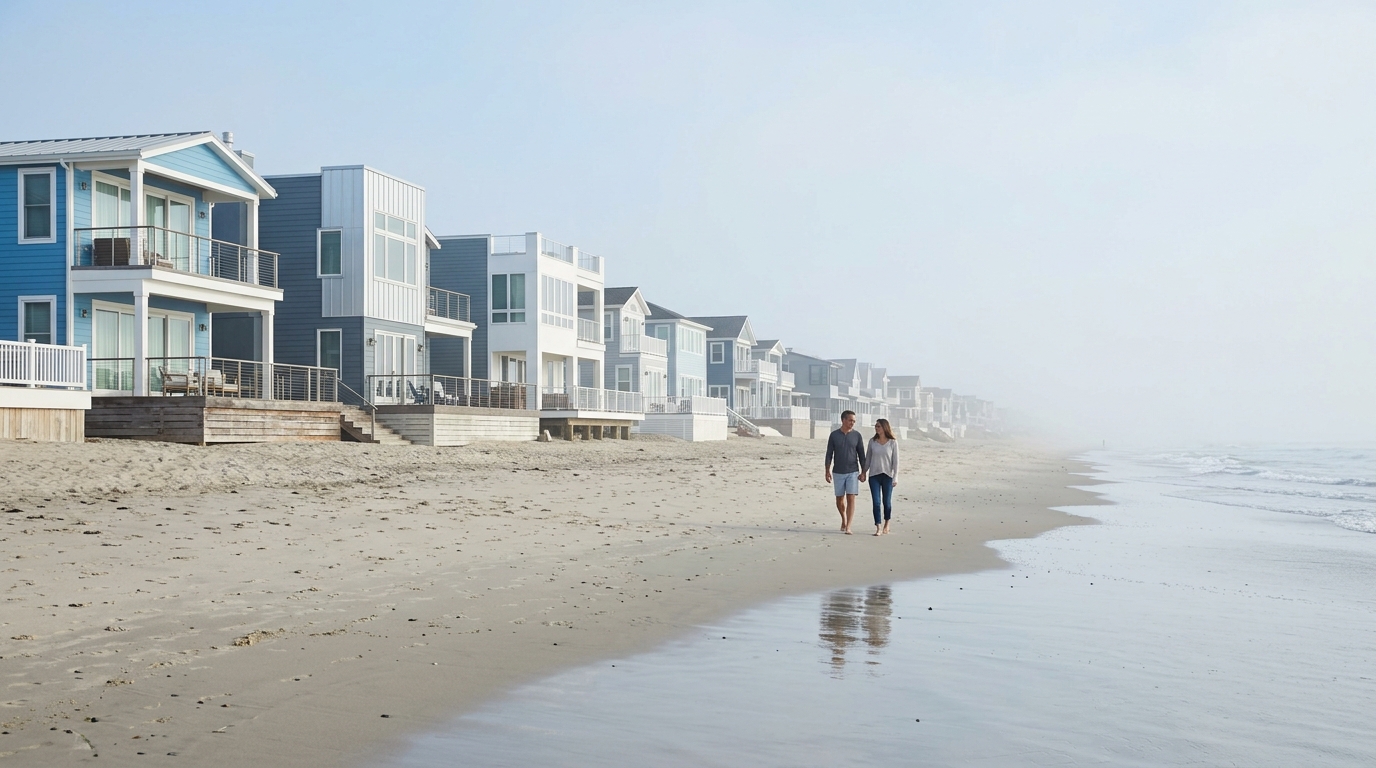
Living in Golden Beach: The Ultimate Guide to Miami's Most Private Oceanfront Town
Golden Beach is Miami-Dade County's most exclusive oceanfront municipality: a 0.3-square-mile town of roughly 900 residents, zero commercial zoning, and direct Atlantic frontage stretching nearly one mile. If you are evaluating the best luxury neighborhoods in Miami, Golden Beach belongs at the top of the shortlist precisely because it offers something no other coastal enclave in the county can replicate: a legally enforced residential-only environment where privacy is structural, not aspirational.
What Makes Golden Beach Different from Every Other Miami Coastal Town
The distinction starts with the town charter. Golden Beach prohibits hotels, retail, restaurants, and commercial signage within its borders. There is one road in and one road out, with a staffed checkpoint at each entrance on Golden Beach Drive. Every vehicle entering is logged. This is not a gated community managed by a homeowners association. It is an incorporated municipality with its own police department, meaning residents enjoy law enforcement authority that private security simply cannot replicate.
The oceanfront itself is private to residents. Unlike the public beaches of Miami Beach or Sunny Isles Beach, the Atlantic shoreline within Golden Beach is accessible only to property owners and their guests. On a Saturday morning, you will share the beach with neighbors, not tourists. That distinction alone commands a substantial premium in the real estate market and explains why buyers relocating from Manhattan's Upper East Side or from London's Mayfair consistently target this address.
Golden Beach vs. Sunny Isles Beach: A Direct Comparison
The question of golden beach vs sunny isles comes up in nearly every buyer consultation involving North Miami Beach's oceanfront corridor. Both communities sit on the same barrier island, separated by a matter of blocks. The lifestyle divergence, however, is significant.
| Factor | Golden Beach | Sunny Isles Beach |
|---|---|---|
| Zoning | Residential only | Mixed residential and commercial |
| Population | Approximately 900 | Approximately 22,000 |
| Beach access | Resident-private | Public |
| Predominant housing type | Single-family estates | High-rise condominiums |
| Entry checkpoint | Yes, 24-hour staffed | No |
| Median single-family price range (2026) | $5M–$25M+ | $1.5M–$8M (condos); $3M–$10M (SFH) |
| High-rise development | None permitted | Extensive, ongoing |
| Commercial amenities within town | None | Shops, restaurants, grocery |
Buyers who want walkable dining and retail choose Sunny Isles Beach. Buyers who want a compound-level residential environment with ocean frontage choose Golden Beach. There is no wrong answer, but there is an honest trade-off: Golden Beach requires driving five to ten minutes to reach Bal Harbour Shops, Aventura Mall, or Hallandale's dining corridor for every errand.
Architecture and Property Characteristics
Golden Beach's housing stock skews toward large-footprint, single-story and two-story estates built directly on the oceanfront or on wide lots east of A1A. The architectural range spans Mediterranean Revival homes from the 1950s through to contemporary glass-and-concrete new construction. Many buyers purchase older homes to tear down and build custom estates, a process that the town's building department facilitates with a relatively streamlined permitting process compared to Miami Beach's historic preservation overlays.
Lot sizes typically run 75 to 150 feet of frontage with depths that allow for full resort-style amenities: beach-to-street lots, lap pools, summer kitchens, and detached guest houses. Setback requirements and height restrictions preserve the low-rise character that distinguishes the streetscape from neighboring Sunny Isles Beach's tower-dominated skyline. Buyers seeking teardown opportunities in 2026 should expect entry-level land pricing to begin at approximately $3M for non-oceanfront parcels, with oceanfront teardowns trading at $8M and above depending on frontage.
Where Golden Beach Fits Among the Best Luxury Neighborhoods in Miami
When buyers ask where to live in Miami within the ultra-luxury single-family category, the shortlist typically includes Indian Creek Village, Coral Gables's Cocoplum and Old Cutler Road estates, Coconut Grove's waterfront streets, and Golden Beach. Each serves a different buyer profile.
- Indian Creek Village offers comparable privacy on Biscayne Bay, but the community is even smaller (roughly 85 residents) and bay-facing rather than oceanfront.
- Coral Gables delivers architectural distinction and walkable village culture but lacks ocean access and carries Miami-Dade's most restrictive historic design codes.
- Coconut Grove appeals to buyers who prioritize urban sophistication and proximity to Brickell, accepting that privacy is managed rather than structural.
- Golden Beach is the only option combining direct Atlantic frontage, a private beach, incorporated town governance, and zero commercial intrusion, all within 25 minutes of Miami International Airport.
For buyers also evaluating bal harbour homes for sale, it is worth clarifying that Bal Harbour is a distinct municipality directly south. Bal Harbour offers its own residential exclusivity with a different product mix: oceanfront condominiums dominate the Bal Harbour market alongside a small number of single-family bay-front properties. Buyers drawn to low-rise estate living almost universally prefer Golden Beach; buyers who want a luxury full-service condominium with concierge and amenities lean toward Bal Harbour or Sunny Isles Beach's branded towers.
Real Estate Market Dynamics in 2026
Golden Beach inventory is structurally constrained. The town contains fewer than 300 parcels total, and oceanfront homes turn over infrequently. In any given year, fewer than 15 single-family transactions close within the town limits. That scarcity supports pricing even during broader market corrections because demand from domestic and international buyers consistently exceeds supply.
In the broader North Miami Beach oceanfront corridor, transaction data from 2025 showed international buyers from South America, Europe, and the Middle East accounting for a significant share of Golden Beach acquisitions, many completing purchases through corporate structures for estate planning purposes. That pattern continues into 2026, supported by Florida's lack of state income tax, the strength of the U.S. dollar as a reserve asset, and Miami's growing position as a global financial center.
Buyers should anticipate that off-market opportunities represent a disproportionate share of Golden Beach transactions. Because inventory is so thin, sellers with significant equity often prefer to transact quietly to avoid the disruption of public listing. Working with a brokerage that maintains direct relationships with Golden Beach homeowners is not a differentiator here: it is a prerequisite for accessing the real market.
Practical Considerations Before Buying in Golden Beach
Golden Beach's desirability does not eliminate due diligence requirements. Several practical factors shape the ownership experience and the purchase negotiation.
- Flood insurance: All oceanfront and near-oceanfront parcels fall within FEMA high-risk flood zones. Annual flood insurance premiums on a large estate can reach $30,000–$60,000 or more depending on elevation certificate results and coverage limits. Buyers should commission an elevation certificate before contract execution to price this accurately.
- Wind mitigation: South Florida's hurricane exposure means wind coverage is separately underwritten. Older structures built before the 2002 Florida Building Code updates carry higher premiums. New construction to current code standards materially reduces this cost.
- Septic vs. sewer: A portion of Golden Beach properties remain on septic systems. Miami-Dade County has expanded its sewer connection program, but buyers should verify current connection status and factor potential upgrade costs into their analysis.
- Beach renourishment: The town participates in periodic beach renourishment programs coordinated with Miami-Dade County. Owners are assessed for a portion of these costs. Review the town's most recent assessment schedule before closing.
- Short-term rental restrictions: Golden Beach prohibits short-term rentals. This is not a neighborhood preference: it is enforced by the town. Buyers seeking income generation through platforms like Airbnb must look elsewhere.
Getting to and from Golden Beach
Golden Beach sits on the Broward-Miami-Dade county line, positioned at the intersection of A1A and the Intracoastal Waterway. Miami International Airport is 25–30 minutes by car via I-95 South. Fort Lauderdale-Hollywood International Airport is 20–25 minutes north, often making it the more practical choice for private aviation and commercial departures. The Brightline rail station at Aventura Mall is approximately ten minutes by car, connecting residents to downtown Miami, Boca Raton, Fort Lauderdale, and Orlando without highway traffic.
The town has no grocery, pharmacy, or gas station within its limits by design. Aventura Mall, Whole Foods, and a full complement of dining and services are accessible within a five-minute drive on William Lehman Causeway. For buyers accustomed to urban walkability, this adjustment requires intentionality. For buyers prioritizing security and quiet, it is a feature, not a limitation.
Golden Beach Living FAQ
Is Golden Beach actually private, or is it marketed as private?
Golden Beach's privacy is legally and structurally enforced. It is an incorporated municipality, not a homeowners association. The town operates its own police department, maintains staffed vehicular checkpoints at both entrances, and enforces residential-only zoning by law. The beach is accessible exclusively to residents and their guests.
How does Golden Beach compare to Bal Harbour homes for sale in terms of property type?
Bal Harbour's residential market is dominated by oceanfront and bay-front condominiums, with a limited number of single-family bay-front estates. Golden Beach is entirely single-family homes and estates on oceanfront or near-oceanfront lots. Buyers seeking a private estate compound choose Golden Beach; buyers seeking luxury condominium living with building amenities and concierge services look to Bal Harbour or Sunny Isles Beach's branded towers.
What is the typical price range for homes in Golden Beach in 2026?
Non-oceanfront single-family homes in Golden Beach trade in the $3M–$7M range depending on size, condition, and renovation status. Oceanfront estates range from approximately $8M for dated properties on smaller lots to $25M and above for recently built or fully renovated large-frontage compounds. Land-only oceanfront parcels suitable for custom construction command $8M–$15M depending on frontage footage.
Are there off-market listings available in Golden Beach?
Yes, and they represent a significant share of the market. Because the town has fewer than 300 parcels and owners are typically high-net-worth individuals who value discretion, many transactions occur before a property reaches public listing platforms. A brokerage with established relationships in the community is the primary access point for these opportunities.
What should buyers know about flood and wind insurance costs in Golden Beach?
All Golden Beach oceanfront properties fall within FEMA high-risk flood zones. Buyers should budget $30,000–$60,000 annually for flood coverage on a large estate, with the precise figure determined by an elevation certificate. Wind insurance is separate and varies by construction date: homes built to post-2002 Florida Building Code standards carry meaningfully lower premiums than older structures. Commissioning both an elevation certificate and a wind mitigation inspection before contract execution is standard practice for informed buyers.