
Navigating a Pre-Construction Contract in Miami: Key Clauses and Pitfalls to Avoid
Miami Pre-Construction Contracts: What Every Buyer Must Understand Before Signing
A pre-construction contract in Miami is a legally binding purchase agreement that locks in your price, unit, and terms before the building exists, typically requiring 20%–50% of the purchase price in staged deposits before closing. The contract is written entirely by the developer's attorneys to protect the developer. Every clause, deadline, and disclosure default benefits one party: the seller. Buyers who sign without independent legal review routinely discover they have accepted liability for construction delays of three or more years, unit modifications they never approved, and deposit structures that leave them with no recovery if they need to exit.
Miami's pipeline of new luxury condominium towers remains one of the most compelling entry points for capital appreciation, but the contract mechanics are non-negotiable until they are negotiated. This guide breaks down the clauses that matter most, the pitfalls that cost buyers the most money, and the due diligence steps that distinguish successful investors from cautionary tales.
The Deposit Structure and What It Actually Means for Your Capital
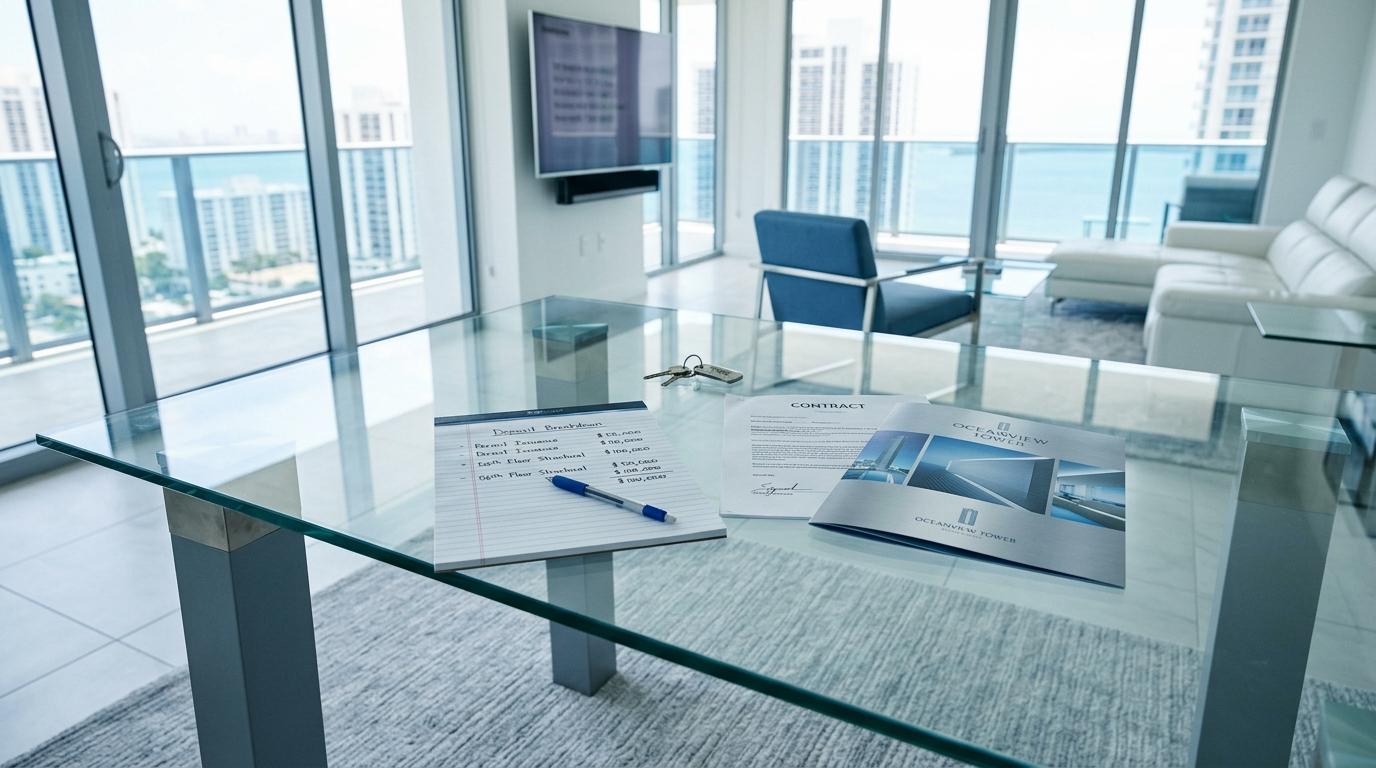
Miami pre-construction deposits in 2026 typically follow a tiered release schedule tied to construction milestones. A standard luxury tower contract might require 10% at signing, 10% when the building permit is issued, 10% when the building reaches the 50th floor or a structural milestone, and 20% at closing. On a $3.5M unit, that is $1.75M committed before you receive a key or can inspect a finished product.
The critical question is where those deposits are held. Florida law under Chapter 718 requires developer deposits to be held in escrow, but the statute permits the developer to withdraw funds for construction costs once they obtain a surety bond or letter of credit. If the developer has posted a bond, your deposit is no longer sitting in a segregated bank account. Confirm in writing whether your deposit is held in a bonded or non-bonded escrow and who the escrow agent is. Request the name of the surety bond provider and its current credit rating before signing.
Buyers in the best new condo buildings in Miami 2026 are negotiating deposit caps and requesting interest-bearing escrow accounts. On contracts above $2M, a buyer's attorney can frequently secure a provision that accrued interest on escrowed deposits is credited to the buyer at closing rather than retained by the developer.
The Developer's Right to Modify Your Unit
Nearly every Miami pre-construction contract includes a "material change" clause granting the developer the right to alter floor plans, ceiling heights, finishes, building amenities, and even the number of units in the building. The Florida Condominium Act grants buyers a right of rescission if a material change is adverse to the buyer, but the threshold for "adverse" is litigated constantly. A reduction in unit square footage of up to 5% is typically not considered adverse under Florida law, meaning you can receive a meaningfully smaller unit with no recourse.
Negotiate explicit caps. Insist on a contract clause stating that any reduction in interior square footage exceeding 2%, any change to the building's parking ratio, or any elimination of a named amenity (specific rooftop pool, private marina access, wine storage) triggers a buyer right of rescission with full deposit return. Named amenities, not generically described amenities, carry legal weight. "A resort-style pool" is unenforceable. "The 57th-floor infinity pool depicted in Exhibit C" creates a measurable standard.
Completion Timelines and the "Outside Closing Date" Clause
Developers project closing dates but rarely guarantee them. The standard Miami pre-construction contract specifies an estimated closing date and then grants the developer the right to extend that date by 12–24 months via written notice, sometimes without limit. You may be locked into a contract for four or five years with no exit right and no compensation for the delay.
The clause buyers must demand is a hard "outside closing date" or "drop-dead date." This is a final deadline beyond which the buyer has the unilateral right to cancel and receive a full deposit refund with interest. Developers resist this clause, but it is negotiable on contracts above $2M in competitive sales environments. Tie the outside closing date to a realistic construction timeline plus 18 months. For a tower in Sunny Isles Beach breaking ground in 2026 with a projected 36-month build, an outside closing date of December 2031 gives the developer runway while protecting your capital from indefinite commitment.
Also review the "force majeure" definition carefully. Post-2020, developer contracts in new developments in Sunny Isles and across Miami Beach have dramatically expanded force majeure language to include supply chain disruptions, labor shortages, and regulatory delays. An overly broad force majeure clause effectively eliminates the outside closing date by categorically suspending the developer's timeline obligations.
Condominium Documents and the 15-Day Review Period
Florida law gives buyers of pre-construction condominiums 15 calendar days to review the condominium prospectus (the "condo docs") after receipt and rescind the contract for any reason, receiving a full deposit refund. This 15-day rescission right is statutory and cannot be waived. Do not allow the developer or their sales team to pressure you into signing during or before this period.
The condominium documents are typically 500–1,200 pages and include the declaration of condominium, association bylaws, rules and regulations, budget, and the purchase agreement. Review the projected operating budget with particular attention to the reserve funding schedule. Florida law now mandates full reserve funding for structural components following the Surfside tragedy, and underfunded reserves in a newly formed association translate directly into special assessments after closing. Confirm that the developer's projected budget reflects fully funded reserves as required under Florida Statute 718.112.
Engage a Miami real estate attorney who has reviewed at least 20 pre-construction condominium prospectuses to conduct this review. A general practice attorney is not sufficient. The review fee of $1,500–$4,000 is the highest-return professional expense a pre-construction buyer can make.
Pre-Construction vs. Resale Luxury Condos: A Structured Comparison
| Factor | Pre-Construction Condo | Resale Luxury Condo |
|---|---|---|
| Deposit requirement | 20%–50% staged before closing | 10% at contract, balance at closing |
| Capital at risk period | 2–5 years before closing | 30–90 days |
| Price appreciation potential | High if market rises during construction | Standard market appreciation from day of closing |
| Customization | Finish selections within developer packages | Post-closing renovation at buyer's discretion |
| Unit modification risk | Developer can alter plans within legal thresholds | None after closing |
| Reserve funding certainty | Projected only, subject to change | Existing and auditable |
| Assignment/flip rights | Developer controls, often restricted | Governed by association bylaws |
| Rental income availability | None until certificate of occupancy | Immediate upon closing |
Assignment Rights and the Exit Strategy Question
Investing in new construction in Miami frequently involves a plan to assign the contract before closing, capturing the appreciation between the original purchase price and the building's market value at completion. Developers have responded aggressively. Most 2025 and 2026 contracts in major towers contain outright assignment prohibitions or require developer consent and a 1%–3% assignment fee paid to the developer on the full sale price.
If assignment is part of your investment thesis, confirm assignment rights before signing, not after. Contracts that permit assignment typically require the assignee to qualify financially under the developer's standards and prohibit assignment in the final 90–180 days before closing. Understand that some buildings with the highest appreciation profiles, particularly branded residences in Bal Harbour and Sunny Isles Beach, carry the strictest assignment restrictions because the developer controls the brand's secondary market positioning.
Red Flags That Should Stop a Purchase
- No construction financing commitment disclosed: If the developer cannot confirm a construction loan is in place or provide evidence of equity funding sufficient to complete the project, the risk of a stalled building is material.
- Escrow held by an affiliate of the developer: The escrow agent should be an independent title company or bank, not a company with common ownership to the developer.
- No buyer rescission right for material changes: A contract with no defined rescission trigger for unit modifications should be renegotiated before signing.
- Sales agent discouraging attorney review: Any sales representative who suggests you waive or rush the 15-day review period is a disqualifying signal.
- Operating budget with reserve waiver: A projected budget that defers or waives reserve contributions in the first years of the association's operation will produce large special assessments.
Miami Pre-Construction Condo FAQ
Can I get my deposit back if I change my mind after signing a Miami pre-construction contract?
Florida law gives buyers a 15-calendar-day rescission window after receiving the condominium documents, during which you can cancel for any reason and receive a full refund. Outside that window, your deposit is at risk unless the contract contains specific rescission triggers such as a material change to the unit or a hard outside closing date that the developer missed.
What percentage deposit is standard for the best new condo buildings in Miami in 2026?
The standard deposit range in 2026 is 30%–50% of the purchase price, paid in staged installments tied to construction milestones. Branded residences and ultra-luxury towers above $5M per unit frequently require 50% in deposits before closing. Entry-level luxury buildings in the $800k–$2M range may offer 20%–30% deposit structures to attract a broader buyer pool.
Are pre-construction condos in Sunny Isles Beach a good investment in 2026?
Sunny Isles Beach has recorded consistent price appreciation in completed luxury towers over the past decade. The investment thesis depends on three variables: the developer's track record of on-time delivery, the contract's assignment and exit provisions, and the specific unit's floor position and view corridor relative to competing inventory. Investors with a 3–5 year horizon and confirmed assignment rights have historically captured 15%–30% appreciation between contract execution and closing in strong market cycles, though past performance does not guarantee future results and each building must be evaluated independently.
What is the most negotiable clause in a Miami pre-construction contract?
The outside closing date and the material change rescission trigger are the most consistently negotiable clauses for buyers purchasing above $2M. Developers are less willing to negotiate deposit structure, assignment rights, or force majeure definitions. An experienced Miami real estate attorney familiar with the specific developer's standard form will know which concessions that developer has granted in past contracts.
Do I need a buyer's agent and a real estate attorney, or is one sufficient?
Both are required and serve distinct functions. A buyer's agent negotiates price, unit selection, and incentives and is typically compensated by the developer at no cost to the buyer. A real estate attorney reviews the legal enforceability of the contract, the condominium documents, the escrow structure, and the developer's financial disclosures. Neither role substitutes for the other. Attempting to use only one creates gaps in protection that developers' contracts are specifically designed to exploit.