
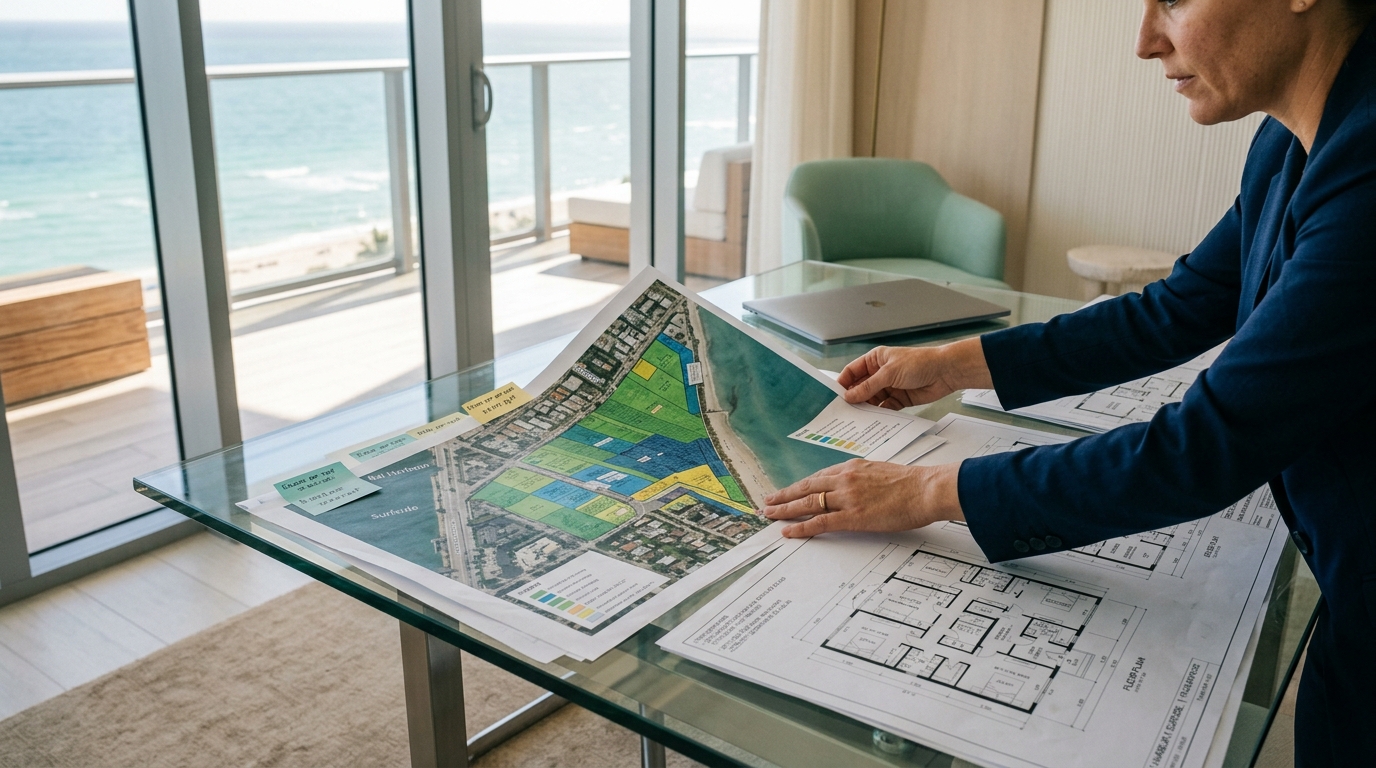
Bal Harbour vs. Surfside: A 2026 Lifestyle & Real Estate Comparison for Luxury Buyers
Bal Harbour vs. Surfside: Which Miami Luxury Community Fits Your Life in 2026?
Bal Harbour and Surfside are two of Miami-Dade's most coveted addresses, separated by a single street yet distinct in character, price point, and lifestyle. Bal Harbour delivers ultra-high-density luxury with median condo prices above $3.5 million and some of the most recognizable retail in the Western Hemisphere. Surfside offers low-rise residential calm, single-family homes with direct Atlantic frontage, and a small-town atmosphere that attracts buyers who want prestige without the tower lifestyle. If you are choosing between these two communities in 2026, the decision hinges on four factors: property type, price-per-square-foot trajectory, access to amenities, and long-term resale dynamics.
Understanding the Geography and Scale of Each Community
Bal Harbour occupies roughly 0.33 square miles on the northern tip of a barrier island. Its residential footprint is almost entirely composed of high-rise and mid-rise condominiums along Collins Avenue, with a handful of co-op buildings dating to the 1960s. The municipality enforces strict zoning that has kept vertical density controlled relative to neighboring Sunny Isles Beach, but the result is still a skyline of branded towers including St. Regis Bal Harbour, The Residences at Bal Harbour, and the architecturally significant Oceana Bal Harbour.
Surfside is marginally larger at approximately 0.56 square miles and sits directly south of Bal Harbour. Its residential DNA is far more varied. Buyers find a genuine mix of single-family homes on interior lots, oceanfront estates, boutique condo buildings typically under 12 stories, and renovated mid-century structures. The town has a walkable downtown grid along Harding Avenue where independent restaurants, bakeries, and local services create a neighborhood feel that larger municipalities in Miami-Dade rarely replicate. Surfside's Jewish community institutions, including a dense corridor of synagogues and kosher establishments, draw a significant international buyer segment, particularly from Israel, Brazil, and Argentina.
2026 Real Estate Market: Prices, Inventory, and Value Trajectory
In 2026, Bal Harbour condominiums in branded towers with direct ocean views are trading in the $2,800–$4,500 per square foot range for turnkey units. Entry-level product in older co-op buildings can still be acquired in the $1,100–$1,600 per square foot range, though those buildings carry strict approval processes and financing restrictions that limit the buyer pool. The St. Regis Bal Harbour residences consistently set record price-per-foot benchmarks in the submarket, with recent three-bedroom sales clearing $6 million.
Surfside's pricing structure is more layered. Oceanfront single-family homes with private beach access are trading at $10 million–$22 million depending on lot size and renovation quality. Interior single-family homes on tree-lined blocks range from $2.5 million to $6 million. Boutique condo product on the ocean in Surfside runs $1,500–$2,800 per square foot, representing a meaningful discount to Bal Harbour tower prices for buyers who prioritize fewer amenities and lower HOA fees. The rebuild activity that followed the 2021 Champlain Towers South collapse has produced a wave of newly permitted construction in Surfside, with several boutique developments featuring modern concrete construction, flood-resilient ground-floor designs, and smart-home integration now delivering units in 2025 and 2026.
| Category | Bal Harbour (2026) | Surfside (2026) |
|---|---|---|
| Predominant Property Type | High-rise and mid-rise condominiums | Single-family homes and boutique condos |
| Oceanfront Condo Price/SF | $2,800–$4,500 | $1,500–$2,800 |
| Single-Family Home Range | Extremely limited inventory | $2.5M–$22M+ |
| HOA Fees (Luxury Towers) | $3,000–$8,000/month | $800–$3,500/month |
| New Construction Activity | Selective tower repositioning | Active boutique development pipeline |
| Rental Market Demand | High seasonal, strong weekly rates | Moderate, longer-term tenant profile |
Lifestyle: Retail, Dining, Beach Access, and Community Feel
Bal Harbour Shops remains the single most productive luxury retail mall in the United States by sales per square foot, hosting Chanel, Prada, Gucci, Louis Vuitton, Dior, and over 100 luxury brands within a lush, open-air environment. For residents of Bal Harbour, this is a walking amenity, not a destination. The trade-off is that Bal Harbour's retail and dining ecosystem is almost entirely oriented toward luxury consumption. Residents seeking casual coffee, a hardware store, or a neighborhood pharmacy will drive or ride out of the village for most everyday needs.
Surfside's Harding Avenue district delivers what Bal Harbour cannot: a pedestrian-scale commercial corridor where residents shop at independent grocers, eat at chef-owned restaurants, and attend community events. The proximity to the Bal Harbour Shops (a five-minute walk or drive north) means Surfside residents access the same retail, but without the premium address pricing baked into their property values. Surfside's beach, which runs the length of the town's Atlantic frontage, is less crowded than South Beach and more accessible than the semi-private beach areas controlled by Bal Harbour condo towers.
For buyers with school-age children, both communities feed into Miami-Dade County public schools, but many families in both municipalities use private institutions in nearby Aventura or Coral Gables. Neither Bal Harbour nor Surfside has a standalone public school within its municipal limits, which is a logistical consideration for families prioritizing school proximity.
Architecture and Building Quality: What Buyers Actually Get
Bal Harbour's premier towers represent some of the most rigorously engineered residential structures in South Florida. The St. Regis Bal Harbour complex, designed by Arquitectonica and completed in phases from 2012 through 2014, features impact-resistant glass systems, private elevator access for individual residences, and a resort-hotel service infrastructure that owners access through shared amenity pools. Oceana Bal Harbour, designed by Enrique Norten, takes a more architecturally adventurous approach with its stacked, terraced massing and a ground-floor aquarium that functions as a landmark amenity. These buildings command premium prices because the product genuinely differentiates: the construction quality, amenity programming, and name-brand hotel management translate into tangible daily experiences.
Surfside's single-family inventory ranges from original 1950s CBS (concrete block structure) homes that have been completely gut-renovated, to contemporary new builds from local architects delivering 5,000–8,000 square foot estates on 75-foot lots. The newer boutique condo buildings completing in 2025–2026 are built to updated Florida Building Code wind-load and flood-elevation standards that exceed the requirements applied to structures built before 2022. For buyers coming from markets like New York or Los Angeles, Surfside's scale of a single-family home with a private pool, two-car garage, and direct beach access represents a lifestyle format that no Bal Harbour condo can replicate regardless of price.
Investment Profile: Which Community Performs for Long-Term Owners?
Bal Harbour's condo market has historically outperformed the broader Miami-Dade luxury condo segment in terms of price appreciation during periods of strong international demand. The branded tower model attracts buyers from Latin America, Europe, and the Middle East who prioritize hotel services, security, and a globally recognized address. This international demand creates a price floor during market corrections and amplifies appreciation during demand surges. The limitation is that HOA fees in branded towers frequently range $4,000–$8,000 per month, compressing net yield for investors who attempt to generate rental income against those carrying costs.
Surfside's single-family homes have demonstrated resilience for owner-occupants with a 5–10 year horizon. The finite supply of oceanfront lots, combined with post-2021 regulatory changes that resulted in the demolition of older structures and their replacement with modern buildings, has reduced the inventory of dated product that historically dragged down market comps. Investors seeking rental yield without large HOA obligations often find Surfside's boutique condo segment, where monthly fees run $800–$2,500, delivers better net operating income than comparable Bal Harbour units at similar purchase prices.
Making the Decision: A Framework for Luxury Buyers in 2026
Choose Bal Harbour if your priorities are: a fully serviced residential lifestyle with concierge, valet, and hotel-grade amenities; direct access to world-class retail as a daily convenience; a condo format that supports a lock-and-leave ownership model; and a globally recognized address that supports resale to an international buyer pool.
Choose Surfside if your priorities are: a single-family home with a private outdoor space and pool; a community-oriented environment where neighbors know each other; lower carrying costs relative to your purchase price; access to new construction built to the latest resilience standards; and a quieter daily rhythm that still places you within walking distance of Bal Harbour Shops and five minutes from Aventura's commercial infrastructure.
Neither community is a compromise. They serve genuinely different buyer profiles, and the strongest outcomes come from buyers who align their purchase with the lifestyle they actually intend to live, not the address they want to be associated with.
Bal Harbour vs. Surfside Luxury Real Estate FAQ
What is the average price of a luxury condo in Bal Harbour in 2026?
Oceanfront condominiums in Bal Harbour's premier towers are trading at $2,800–$4,500 per square foot in 2026. A two-bedroom unit in a branded building such as St. Regis Bal Harbour or Oceana Bal Harbour typically starts above $2.5 million, with three-bedroom and penthouse units regularly exceeding $6 million.
Can I find a single-family home in Bal Harbour?
Single-family home inventory in Bal Harbour is extremely limited. The municipality is almost entirely built out with mid-rise and high-rise residential towers. Buyers seeking a house with a private yard and pool in this submarket almost always look to Surfside, Bay Harbor Islands, or Indian Creek Island instead.
How has Surfside's real estate market changed since 2021?
Following the 2021 Champlain Towers South collapse, Surfside implemented enhanced structural inspection requirements and a number of older buildings were either demolished or underwent major remediation. This resulted in a reduction of outdated inventory and a pipeline of new boutique developments built to stricter engineering standards. By 2025 and into 2026, these new buildings have added modern, resilience-code-compliant product that has supported price appreciation in the town's condo segment.
Which community is better for international luxury buyers?
Bal Harbour draws the larger international buyer segment, particularly from Latin America and Europe, due to its branded tower infrastructure, hotel services, and globally recognized address. Surfside draws a strong international presence as well, concentrated among buyers from Israel, Brazil, and Argentina, partly because of the community's established Jewish institutions and kosher dining infrastructure along Harding Avenue.
Are off-market listings common in Bal Harbour and Surfside?
Off-market transactions are frequent in both communities, particularly at the $5 million and above price point. Many sellers in branded Bal Harbour towers and owners of oceanfront Surfside estates prefer to transact privately to avoid public price discovery, protect personal privacy, and limit showing disruptions. Working with an agent who maintains direct relationships with owners in these specific buildings and blocks is the most reliable way to access inventory before it reaches public listing platforms.