
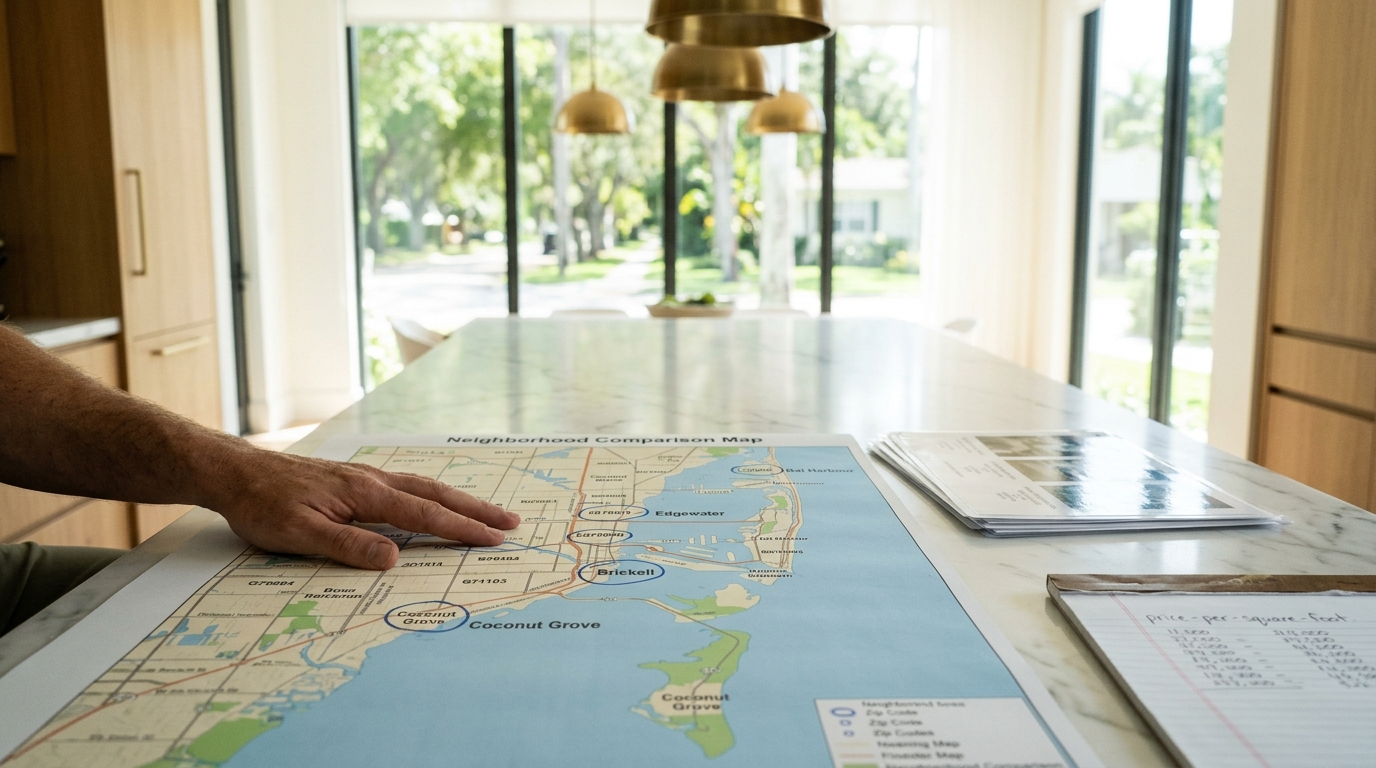
Miami Neighborhood Deep Dives for the Discerning Relocating Buyer
Miami's luxury residential market in 2026 is not one market: it is eight or nine distinct submarkets, each with its own price architecture, lifestyle profile, and investment logic. Relocating buyers who treat Miami as a monolith routinely overpay, buy in the wrong zip code for their daily routine, or miss off-market inventory that never reaches a public listing platform. This guide gives you the mechanics you need to evaluate the top neighborhoods side by side and make a decision you can defend financially and personally.
Why Neighborhood Selection Is a Financial Decision, Not Just a Lifestyle One
Luxury real estate appreciation in Miami is hyperlocal. Between 2020 and 2025, median closed prices per square foot in Bal Harbour waterfront condos outpaced comparable Brickell product by roughly 28%, according to tracked MLS data for that period. That gap was not arbitrary: it reflected a constrained land supply, strict height limits, and a buyer pool that skews toward ultra-high-net-worth international purchasers. Understanding why one submarket commands a premium over another lets you evaluate whether that premium is durable or cyclical before you wire a deposit.
The four variables that drive long-term value in any Miami luxury submarket are: land scarcity, zoning protection, quality of the immediate retail and dining corridor, and school district access (relevant even for buyers without children, because it defines the resale universe). Run every neighborhood through those four filters before you fall in love with a floor plan.
Bal Harbour and Surfside: Controlled Supply, Concentrated Demand
Bal Harbour is 0.27 square miles. That is not a typo. The village's land area is finite, its zoning board is famously conservative, and the Bal Harbour Shops anchor anchor the neighborhood as one of the highest-grossing retail nodes per square foot in the United States. Those structural facts translate directly into price floors that hold even during broader market corrections.
The dominant product type here is large-format oceanfront condominiums: Oceana Bal Harbour, St. Regis Bal Harbour, and One Bal Harbour represent the benchmark inventory. In 2026, resale units in these buildings are trading in the $2,500–$4,200 per square foot range depending on floor, exposure, and renovation condition. New developer pricing, where available, opens above that band.
Adjacent Surfside expanded its profile dramatically after the Champlain Towers collapse in 2021 triggered a wave of older building exits, fresh construction, and reinforced buyer confidence in newer inventory. The Four Seasons Private Residences Surf Club, completed before that wave, remains the neighborhood's prestige benchmark. Buyers relocating from New York or Los Angeles who want walkable beach access without the density of South Beach consistently rank this corridor at the top of their shortlists.
Trade-off to understand: there is almost no single-family home inventory here. If your lifestyle requires a private yard, motor court, or guest house, Bal Harbour is not your market.
Coral Gables: Historic Permanence and the Private School Belt
Coral Gables operates under a city planning framework that has been largely intact since George Merrick's original 1920s master plan. Mediterranean Revival architecture, canopy tree ordinances, and strict signage codes create an aesthetic consistency that does not exist anywhere else in Miami-Dade County. For buyers who want a neighborhood that will look substantially the same in twenty years, that regulatory permanence is a meaningful asset.
The primary luxury product in Coral Gables is single-family estates, concentrated along Arvida Parkway, Old Cutler Road, and the canal-front streets that connect to Biscayne Bay. Lot sizes range from 10,000 square feet for interior parcels to over two acres for bay-front properties. In 2026, bay-front estate pricing ranges from $12M to north of $35M for turnkey product on large lots. Interior estate homes with guest houses and pool casitas in the $3M–$7M range represent the neighborhood's broadest market segment.
The Gables is also home to Ransom Everglades and Carrollton School of the Sacred Heart, two of Miami's most academically competitive private schools. For families relocating with children in middle or high school, proximity to those campuses materially affects morning logistics and extracurricular scheduling. That demand pool is stable and deep, which supports resale liquidity even when the broader luxury market softens.
Trade-off: Coral Gables is a 20–30 minute drive from Miami Beach without traffic. Buyers who want to be on the sand in ten minutes will find the commute friction real.
Miami Beach and Sunset Islands: Brand Recognition with Nuanced Submarket Differences
Miami Beach is not a single neighborhood. It is a barrier island with seven or eight distinct residential pockets that differ substantially in density, noise profile, and price behavior. South Beach south of Fifth Street is the entertainment district: buyers who purchase there are buying a lifestyle asset that functions more like a hotel in terms of usage patterns. North of 41st Street, the residential character shifts toward mid-island neighborhoods like La Gorce, Normandy Isles, and the Sunset Islands.
The Sunset Islands (I through IV) are the most coveted single-family addresses on Miami Beach. These are gated or de facto private island streets with deep-water dockage, minimal through traffic, and immediate Biscayne Bay access. In 2026, Sunset Island waterfront homes trade from $15M to over $50M for generational trophy product. The lot supply is permanently fixed because the islands were created by dredge-and-fill a century ago; there is no new land coming.
Buyers who want a boat slip, a private pool, proximity to the beach, and access to the Design District and Wynwood in under fifteen minutes should evaluate Sunset Islands and La Gorce Island seriously before looking anywhere else in Miami-Dade.
Sunny Isles Beach and Golden Beach: The Ultraluxury Tower Corridor
Sunny Isles Beach hosts the most concentrated cluster of branded ultra-luxury residential towers in the continental United States. Porsche Design Tower, Armani/Casa Residences, Regalia, and the Bentley Residences (delivering in 2026) define a product category that does not have a domestic competitor outside of Manhattan. These buildings attract a primarily Latin American and European buyer pool who treat the units as primary residences, pied-à-terres, or both.
What distinguishes this corridor functionally from Bal Harbour is the price-per-square-foot entry point and the amenity race between developers. Porsche Design Tower's car elevator concept set a benchmark in 2017 that every subsequent building has tried to top. Buyers in this corridor are purchasing a brand experience as much as a residence, and the resale market reflects that: unit condition and original finish level matter less than building brand recognition to the resale buyer pool.
Immediately north, Golden Beach is a 58-home municipality with no commercial development, no hotels, and a single access road. It is the most private oceanfront address in Miami-Dade and trades at a significant scarcity premium. Single-family oceanfront lots do not reach the open market more than two or three times per decade; most transactions happen off-market through direct relationships.
Neighborhood Comparison: Key Metrics for Relocating Luxury Buyers
| Neighborhood | Primary Product Type | 2026 Price Range (Entry Luxury) | Boat Dockage Available | Best Fit Buyer Profile |
|---|---|---|---|---|
| Bal Harbour / Surfside | Oceanfront condominiums | $2.5M–$15M+ | No direct dockage | Beach-primary buyer, no yard needed |
| Coral Gables | Estate homes, canal and bay-front | $3M–$35M+ | Yes (canal and bay) | Family, school-focused, privacy-driven |
| Sunset Islands / La Gorce | Waterfront single-family | $8M–$50M+ | Yes (deep water) | Boater, beach proximity, urban access |
| Sunny Isles Beach | Branded luxury towers | $2M–$30M+ | Limited marina options nearby | International buyer, amenity-focused |
| Golden Beach | Oceanfront single-family | $10M–$40M+ | No direct dockage | Ultra-privacy, trophy asset buyer |
How to Structure Your Search Before You Arrive
Relocating buyers who arrive in Miami without a pre-qualified neighborhood shortlist lose weeks to exploratory showings that accomplish nothing strategic. Before your first site visit, define three things: your non-negotiable lifestyle features (ocean view, boat slip, yard, walkability), your usage pattern (full-time residence vs. seasonal), and your five-year exit thesis (do you need easy resale liquidity, or are you comfortable holding a trophy asset with a narrow buyer pool?). Those three inputs will eliminate two or three neighborhoods from consideration before you board a plane.
Off-market inventory is disproportionately important in the $10M+ segment. A significant share of transactions at that price level in 2026 close without a public MLS listing. Engaging an advisor with verified seller relationships in your target neighborhoods is not optional at that price point: it is the only way to access the full inventory universe.
Relocating Buyer Neighborhood FAQ
Which Miami neighborhood has the most stable long-term appreciation for a luxury buyer?
Bal Harbour and the Sunset Islands have demonstrated the most consistent price floor stability over the past two decades because both are supply-constrained by geography or regulation. Bal Harbour's 0.27-square-mile boundary and Sunset Islands' fixed land mass prevent the supply dilution that softens prices in less constrained submarkets.
Is Coral Gables a good choice for international buyers who want a primary residence rather than a seasonal unit?
Yes. Coral Gables has the deepest full-time residential infrastructure of any luxury submarket in Miami-Dade: top private schools, a functioning village commercial district, a hospital system (Baptist Health), and a 20-minute expressway connection to Miami International Airport. International buyers establishing a primary U.S. base consistently rank it ahead of beach-oriented alternatives for those reasons.
How does the Sunny Isles Beach tower market perform as a rental asset when not owner-occupied?
Branded towers in Sunny Isles Beach generally permit short-term rentals, which distinguishes them from many Bal Harbour and Miami Beach buildings that restrict rental durations. Gross rental yields in these buildings in 2026 run 3.5%–5.5% annually depending on unit size, building brand, and management approach. Net yields after HOA fees and management costs are lower; buyers should underwrite conservatively at 2.5%–3.5% net before factoring appreciation.
What does "off-market" actually mean in Miami luxury real estate, and how do buyers access it?
An off-market property is one where the seller has authorized a specific broker to represent the home to qualified buyers without entering the property into the MLS. Access comes through direct broker relationships, not search portals. At the $10M+ price level, a meaningful share of available inventory sits off-market at any given time. Buyers access it by working with an advisor who is actively networked in the specific submarket they are targeting, not by broadening their portal search.
How should a relocating buyer evaluate a new development pre-sale versus a resale unit in the same building or neighborhood?
Pre-sale purchases offer pricing at or near today's land and construction cost basis with delivery 24–48 months out. The risk is execution: construction delays, finish substitutions, and market shifts during the build period. Resale units in established buildings allow physical inspection, immediate occupancy, and a known HOA financial track record. For buyers who need to be in Miami within 12 months, resale is the only realistic path. For buyers with flexibility and a strong appetite for the specific building brand, pre-sale in a creditworthy developer's project can offer a 10%–20% discount to projected delivery value.